Strategy
Making PR Strategy Part of Your Go-To-Market System


Most B2B executives have a terrible relationship with PR. You've been burned by expensive press releases that went nowhere. You've paid $5,000 to PR Newswire, then another $500 just to fix a typo. You've watched your marketing team chase vanity metrics while your pipeline stayed empty.
So when someone suggests investing in a PR strategy, your first instinct is to say no.
But you're rejecting something much narrower than what PR strategy actually means. You think you're declining press releases and media placements. What you're really turning down is a systematic approach to building credibility, controlling your narrative, and creating the context that makes selling easier.
The problem isn't PR strategy itself. The problem is that most people define it too narrowly, confusing the tactics (press releases, media kits, journalist outreach) with the actual strategic work of establishing authority and trust in your market.
What PR Actually Means Today
Public relations has changed dramatically from its print-media origins, but the core hasn't shifted at all. PR is about connecting with audiences that matter to you in ways that matter to them. That's it.
The channels keep changing. Print became television, which became internet, which became blogs, which became LinkedIn and podcasts. Every few years, someone declares everything is different now. But the fundamentals remain constant: identify who influences your target audience, then build relationships with those influencers.
The problem is that most PR firms haven't helped business leaders understand this distinction. They've let the impression persist that PR means drafting press releases and hoping someone reads them. That's not PR. That's lazy execution masquerading as strategy.


Selling a Hard Concept? Try PR
Back in the day, a quantum computing company was getting terrible press coverage. They couldn't figure out why every article painted them negatively.
The answer turned out to be 12 computer science professors.
These 12 academics were the go-to sources for every major tech reporter covering quantum computing. They didn't like the company's technical approach. So every time a journalist called for background or commentary, these professors undermined the company.
The PR solution wasn't more press releases or better media training. It was building relationships with those 12 professors so they understood the company's approach better. Once those relationships shifted, the media coverage flipped.
That's modern PR. It's targeted, relationship-driven, and focused on the specific people who influence your buyers.
PR strategy isn't a separate function. It's a set of tactics and channels within your larger go-to-market system.
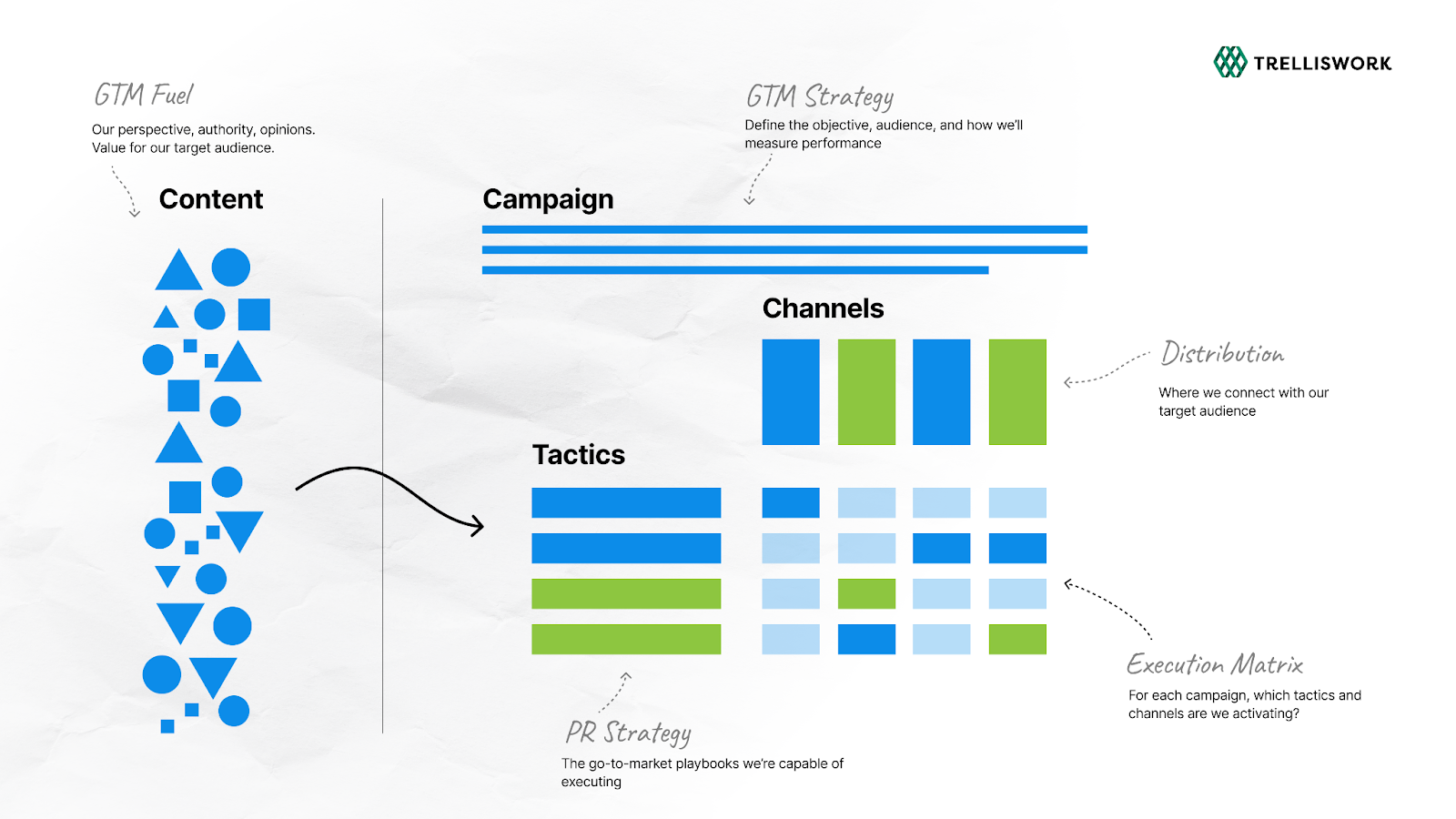
You already have foundational GTM elements: your ideal customer profile, your market focus, your brand promise. PR strategy applies those same foundations to a different set of tactics. Instead of email sequences or paid ads, you're using media relationships, thought leadership, and third-party validation. But the strategic inputs are identical.
This matters because PR can't work in isolation. It relies on the same ICP definition that guides your sales targeting. It reinforces the same brand promise that your marketing team communicates. It reaches the same narrow audience, just through different distribution channels.
Think of PR as a campaign grouping within your GTM system. You might run a content campaign, a demand gen campaign, and a PR campaign, all aimed at the same 500 target accounts. Each uses different tactics. Each measures different leading indicators. But they all ladder up to the same business outcomes.
Good PR gets prospects to the top of your funnel. But it also supports them throughout their buying journey. When a prospect gets cold feet during your sales process, an article or case study that appears at the right moment moves them forward. When they're doing due diligence, external validation from credible sources reinforces that your company is legitimate.
This is why PR should never be measured in isolation. The question isn't "how many press mentions did we get?" The question is "did this move our target audience toward the action we want them to take?"
If you're a mid-market company selling to healthcare CIOs, your PR strategy might involve three different campaigns: one for all healthcare CIOs broadly, one for CIOs in specific geographic markets, and one for CIOs who listen to particular podcasts. Each campaign drives specific outcomes that connect to your pipeline.
The Credibility Hierarchy
Not all channels carry equal weight. A feature in a major industry publication carries more credibility than a post on your company blog. An interview with a tough questioner carries more weight than a conversation with your business partner where you get softball questions.
This matters because credibility is the currency of PR. The more risk involved in a channel, the more credibility it typically carries. Reporters are paid to be objective, to represent their readers, and to question what executives tell them. When you survive that scrutiny and your message comes through intact, people trust it.
The same principle applies to other channels. A detailed customer case study where the client speaks honestly about implementation challenges carries more weight than marketing copy about your solution. A LinkedIn post where you share what went wrong on a project (and what you learned) builds more authority than 50 posts about your company's latest features.
Good PR guides you through these riskier channels. It helps you earn credibility in ways that actually change how your audience perceives you.
When You Actually Need PR Strategy
In simple terms, you need PR strategy when your buyers won't take meetings based on your outbound alone.
If your ideal customers are executives who check industry publications before returning calls, you need PR. If they ask their network about vendors before booking demos, you need PR. If they're influenced by what analysts say or what their competitors are doing, you need PR.
Most mid-market B2B companies face this reality fast. Their buyers don't respond to ads. They don't fill out lead forms. They want proof you're credible before they'll invest time talking to you.
Good PR delivers that proof. It creates the external validation that makes your sales team's job easier. It answers the "who else uses you?" question before prospects even ask it.
Think about your next 10% of revenue growth. Who are those buyers? What convinced the last three deals to say yes? If third-party credibility played any role in closing those deals, you need a PR strategy that creates more of it.
What AI Changes (And What It Doesn't)
AI tools help with PR strategy in specific ways. They're excellent at surfacing patterns and historical context. If you want to understand how other companies successfully repositioned in their markets, AI can point you in the right direction fast.
But AI-generated content has a problem. Most of what you get on first pass is generic slop. The output is better than what was possible two years ago, but there's no easy button that gets you the results you want.
AI becomes useful when you train it on your specific voice and perspective. This takes work. You can't use generic prompts and expect good results. But if you invest in training an AI tool to understand how you think and communicate, it can help you scale your thought leadership more efficiently.
The catch is that you need a distinctive voice in the first place. You need to know what you uniquely have to offer. You need positions and perspectives that come from real experience, not from regurgitating what everyone else says.
AI can accelerate production. It can't create the authentic perspective that makes your PR strategy work.
The Voice Problem
Most B2B companies struggle to develop a distinctive voice because they're afraid of closing doors. If you take a position, you might alienate potential customers. If you share a contrarian view, someone might disagree.
But generic positioning means no one listens at all.
Authenticity is what matters most. In a market saturated with AI-generated content and corporate-approved messaging, being real is your competitive advantage. Your prospects can smell manufactured authority from a mile away. They trust voices that sound like actual human experience, not committee-approved talking points.
This is what you're actively trying to bring out in your content. Not controversy for its own sake. Not hot takes designed to generate clicks. Just your actual perspective, grounded in what you've seen and done, communicated in a way that sounds like a real person talking.
You don't need to be controversial or pick fights. You need to have a perspective grounded in your real experience. When Anderson Consulting (now Accenture) declared in the late 1990s that technology drives strategy, not the other way around, they took a position that contradicted conventional wisdom. McKinsey and Boston Consulting Group disagreed.
Anderson Consulting turned out to be right. That perspective, consistently communicated across media relations, advertising, and sales conversations, helped fuel their growth into what became a massive global firm.
Your voice should reflect what you actually believe based on what you've seen and done. It should connect to problems your ideal customers face. It should give you something to rally around internally and something that makes prospects pay attention.
If you're a services company that lives and dies by client work, it's tempting to say yes to everything. But trying to solve every problem for everyone means you have nothing distinctive to say. Find the problem you solve better than anyone else. Build your voice around that.
Making PR Strategy Work
Good PR should be project-based, measurable, and finite. You shouldn't feel like you need PR people working for you forever. Start with specific goals tied to specific outcomes.
Maybe you need to flip the perception of 20 key prospects who currently buy from a competitor. Maybe you need to establish credibility with a new industry vertical. Maybe you need to position your CEO as a thought leader on a particular topic that matters to your buyers.
Define the goal clearly. Understand who influences the audience you're trying to reach. Then build a strategy to reach and persuade those influencers. In some cases, that might mean traditional media relations. In other cases, it might mean having coffee with six people who shape how your industry thinks.
The strategy should integrate completely with your broader go-to-market approach. Your PR efforts should reinforce your marketing campaigns and sales conversations. Your marketing content should build on the credibility your PR creates. Everything should point in the same direction.
And you should be able to explain clearly how the investment connects to pipeline and revenue. If you can't draw that line, either the strategy is wrong or you're not measuring the right things.
Are You Asking the Right Question?
The question isn't whether you need a PR strategy. The question is whether you're willing to do the hard work of figuring out what you stand for, who you're trying to reach, and what you want them to do.
If you can answer those questions clearly, PR becomes a practical tool for reaching and influencing the people who matter most to your business. If you can't answer them, no amount of press releases or media training will help you.
Start there. Figure out your voice. Understand your audience. Define the action you want them to take. Then build a strategy that connects those dots.
That's PR. Everything else is just tactics.
FAQs
What is B2B PR strategy?
B2B PR strategy identifies who influences your buyers and builds relationships with those influencers. It's not press releases. It's targeted credibility building that moves specific audiences toward specific actions.
How is PR different from marketing?
PR earns credibility through independent validation. Marketing promotes directly. Think of it this way: PR gets prospects to the top of your funnel through trusted third parties like industry analysts, media, or peer recommendations. Marketing guides them through to conversion. PR prepares the field. Marketing plants and harvests. Both need to work together, with your PR creating the external validation that makes your marketing messages believable.
When should a company invest in PR?
When your buyers trust peer recommendations and industry experts more than your marketing. If prospects research extensively before talking to sales, you need PR.
Why do most companies fail at PR?
They spray generic press releases hoping someone notices. They don't know who they're trying to reach or what action they want. They measure press mentions instead of pipeline impact. Good PR requires knowing exactly which 50 people influence your best prospects, then systematically building relationships with those 50 people. Most companies skip that targeting work and wonder why their PR investment goes nowhere.
What does a PR strategy cost?
Expect $3,000-$15,000 monthly for project-based work. Start with 3-6 months targeting specific outcomes. Avoid open-ended retainers.
Should we hire in-house or use a consultant?
Use a consultant. In-house PR only makes sense at scale. Consultants bring cross-industry experience and established relationships. Start project-based, then evaluate.
How long before PR shows results?
Quick wins happen in 30-60 days. Relationship-driven PR takes 3-6 months for measurable impact. Sustainable authority that consistently drives pipeline takes 6-12 months. You're building trust and credibility, not running ads. Expect momentum to build as influencers start associating your company with specific expertise, then recommending you unprompted.