
AUTHOR

Chris Garvey

Articles and GTM thought leadership.

Search icon
categories
Thank you! Your submission has been received!
Oops! Something went wrong while submitting the form.
Articles

December 19, 2025

We tested AI visibility tools from SEMrush, Ahrefs, and Mentions. The data just isn't there yet. Here's what you should focus on instead.

Every B2B marketing leader has heard the warnings by now. Google traffic is declining. ChatGPT is replacing search for research. Your buyers are asking LLMs for vendor recommendations, and you have no idea if your brand even shows up.

The SEO tool vendors see this shift too. SEMrush, Ahrefs, and newcomers like Mentions are rolling out "AI visibility" features that promise to track how often your brand appears in LLM responses. The pitch is compelling: if your buyers are using AI to research solutions, shouldn't you know whether ChatGPT recommends your competitors instead of you?

We decided to test these tools across our own properties and several client sites. Not to write an official vendor comparison (yet), but to answer a practical question: is there any real benefit to investing in AI visibility tracking today?

The short answer: not yet.

The tools show promise, but the data infrastructure isn't there. More importantly, anyone claiming they've cracked the code on how to manipulate LLM visibility is lying. These systems are still largely a black box, and the theories about how to game them are just that: theories.

What we found, and what you should focus on instead.

The Current State of AI Visibility Tools

The concept makes sense in theory. Just like you track keyword rankings in Google, you should track "prompt rankings" in ChatGPT, Claude, Gemini, and Perplexity. You want to know how often your brand appears, what prompts trigger mentions, and how you stack up against competitors.

The tools we tested claim to deliver these insights. In practice, they provide dashboard scores without the substance you need to act on them.
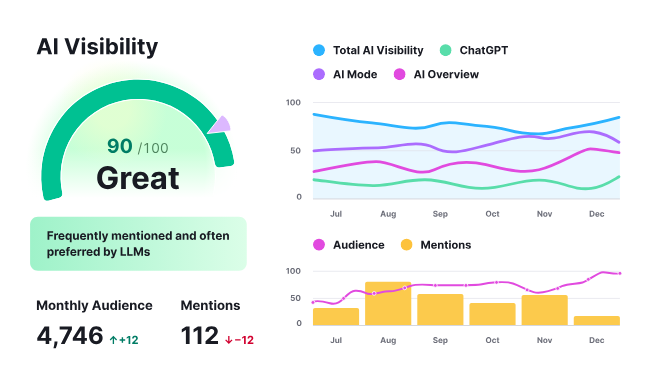
An optimistic marketing sample from SEMRush. Reality check: none of the companies we tested scored above a 35 and several were zeros. Perhaps a challenge with smaller companies, but there just isn’t enough data or related LLM queries to provide a score.

Zero Visibility Doesn't Mean Zero Impact

If you're not a household brand with massive search volume, expect to see mostly zeros in your dashboard. The tools assign you an "AI visibility score," but provide almost no context for what drives that number.

One client site we tested scored a 0. Their direct competitor scored a 35/100. Sounds concerning, right? Except there's no breakdown of which prompts drove that 35, how many actual appearances that represents, or what content made them visible. You can't reverse engineer success when the underlying data isn't exposed.

This isn't like traditional SEO, where you can identify long-tail keywords, see monthly search volume, and build an optimization plan. The LLM vendors aren't sharing prompt data at scale. OpenAI doesn't provide a "Search Console for ChatGPT." Neither does Anthropic for Claude, or Google for Gemini.

The AI visibility tools are trying to fill a gap that's mostly still empty.

The Data Problem Is Foundational

These tools are building on quicksand.

Google Search Console exists because Google wants site owners to improve their content. Better content creates better search results. The incentive structure works for everyone.

LLM providers haven't opened up that same transparency yet. You can't see which prompts mentioned your brand, how often you appeared in responses, what context surrounded those mentions, or whether users took action afterward.

Some tools are scraping what they can or running test prompts at scale to simulate visibility. But it's a thin dataset compared to the depth available for traditional search. Until the LLM vendors provide real transparency, these tracking dashboards are measuring shadows.

One Thing Works: The ICP Exercise

Mentions does something valuable that has nothing to do with tracking. Their onboarding takes a crack at creating your ideal customer profile after some general questions. It identifies competitors, articulates differentiators, and maps the questions buyers naturally ask based on services and does a decent job of it so you can quickly edit or replace what it creates. 

This exercise matters. It pushes you to think about brand positioning in the context of conversational queries, not just keyword strings. If someone asks an LLM, "What tools help B2B companies improve pipeline visibility without adding headcount?" how should your brand be described in that response?

That's a strategic question worth answering, regardless of whether you can track the results.

But after building that foundation, the tool primarily tracks prompts that explicitly mention your company name. Of course you appear in those results. The more valuable question is whether you surface in category-level or problem-level queries where your name isn't mentioned at all.

Those are the prompts that drive net-new awareness. And the tools can't reliably track them yet.
Traditional SEO Vendors Are Adding Bolt-On Features

SEMrush and Ahrefs are layering AI visibility modules into their existing platforms. On the surface, this seems efficient. You already pay for these tools, so why not get AI metrics in the same dashboard?

The risk is they're applying an SEO framework to a fundamentally different problem. AI visibility isn't just about keywords and backlinks. It's about how your brand narrative gets synthesized into conversational responses. It's about authenticity, context, and the authority signals that LLMs use to decide what's worth citing.

If you optimize for trigger words without understanding how LLMs construct answers, you might improve a score that doesn't correlate with actual buyer influence.

What You Should Do Instead

If the tracking tools aren't ready, what's the alternative? Focus on the fundamentals that drive AI visibility, whether you can measure it precisely or not.

Build Content That LLMs Want to Reference

LLMs are trained on public content and retrieve from indexed sources during inference. If your content is thin, generic, or keyword-stuffed, it won't surface in AI responses no matter what your dashboard says.

Write content that demonstrates real expertise. Address specific buyer problems with depth. Provide clear points of view backed by experience. This is what gets cited when an LLM synthesizes an answer.

Forget the tricks. There are no tricks yet. Anyone who tells you they've reverse-engineered the ranking algorithm for ChatGPT is selling you something they don't have. These systems are black boxes, and the theories floating around are mostly speculation dressed up as strategy.

What works is the same thing that's always worked: create content valuable enough that it becomes a source of truth in your space.

Make Your Content Crawlable and Structured

LLMs need to access your content to reference it. That means basic technical hygiene matters more than ever.

Ensure your site is crawlable. Use clear URL structures. Format your pages with proper headings, lists, and semantic HTML. Make it easy for both traditional search engines and AI systems to parse what you're saying.

If you have key service pages, product explainers, or methodology documentation, structure them clearly. Use headings to break up sections. Include definitions for important terms. Link to authoritative sources that support your claims.

This isn't new advice. It's just more important now.

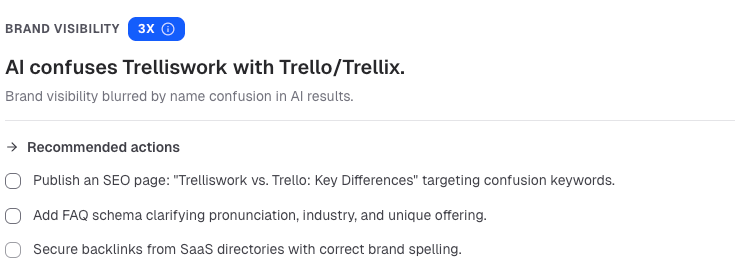
More kudos to Mentions in this feature area, they provided the most depth on suggestions of structured content that might improve your “score.” Most were obvious: write about the topics that involve your services or customer problems identified in their ICP analysis.  However, Mentions also attempted to diagnose general some visibility problems with your brand and suggested content pieces unrelated to services (e.g. write a blog post specifically focused on who is Trelliswork so that the LLMs can fill in the gaps on what they glean from pages, FAQs, and services pages).

Link to Authoritative Sources (And Earn Backlinks)

LLMs weight authority when deciding what to include in responses. That authority comes partly from who links to you and who you link to.

Build relationships with credible sources in your industry. Contribute to publications that matter. Get cited in research reports, analyst briefs, and case studies from recognized firms.

When you publish your own content, link out to authoritative sources that support your points. This isn't just good practice for readers. It signals to AI systems that your content exists in a network of credible information.

Define How You Want to Be Described

Think about how you want an LLM to describe your company when someone asks about your category. What's your core differentiation? What problems do you solve that competitors don't? How would you explain your value in two clear sentences?

Document this. Make it public. Repeat it consistently across your site, case studies, thought leadership, and any content you control.

LLMs synthesize from available sources. If your positioning is clear and consistent everywhere, that's what gets reflected in AI responses. If it's muddled or contradictory, the LLM will struggle to represent you accurately.
Test Your Own Visibility Manually

You don't need a paid tool to understand your AI presence. Open ChatGPT, Claude, Perplexity, or Gemini. Ask the questions your buyers would ask. See what shows up.

Try variations:

  • "What are the best tools for [your category]?"
  • "How do B2B companies solve [problem you address]?"
  • "What should I look for when evaluating [your solution type]?"

Does your brand appear? If yes, how is it described? If no, look at what does appear. What made that content authoritative enough to reference? What sources get cited?

Reverse engineer those patterns. Look at the structure, depth, linking behavior, and positioning of the content that wins. Then build your own content strategy around those observations.

This is manual and time-consuming. But it's more actionable than a dashboard score you can't interpret.

Promote Your Content in Traditional Ways

AI visibility doesn't replace traditional distribution. It complements it.

Keep promoting your content through email, social, partner channels, and any other distribution you've built. The more your content gets read, shared, and linked to, the stronger the authority signals become. Those signals matter for both traditional search and AI discoverability.

Don't abandon what works in pursuit of a new metric you can't control yet.

The Vanity Metrics Problem

You could add these AI visibility tools to your stack today, get a score, and have no idea what it means or what to do about it.

If your score is high, great. But why? If it's low, what's the actual fix? The tools don't provide enough depth to connect visibility to action.

This is dangerous for marketing leaders who need to justify spend and show progress. A static or declining AI visibility score without context creates pressure to "do something" without clarity on what that something should be.

You risk adding another dashboard that looks important but doesn't drive real decisions. That's the definition of a vanity metric.
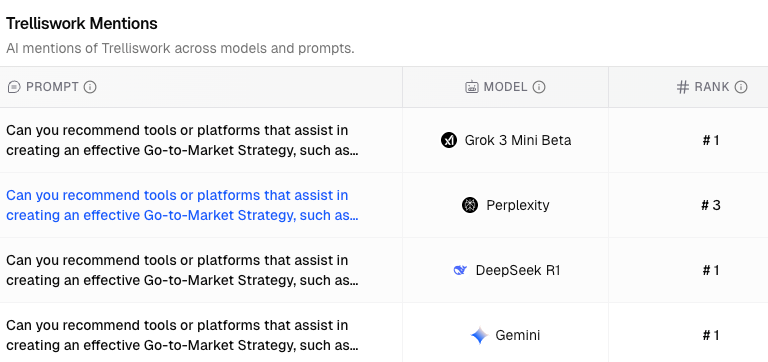

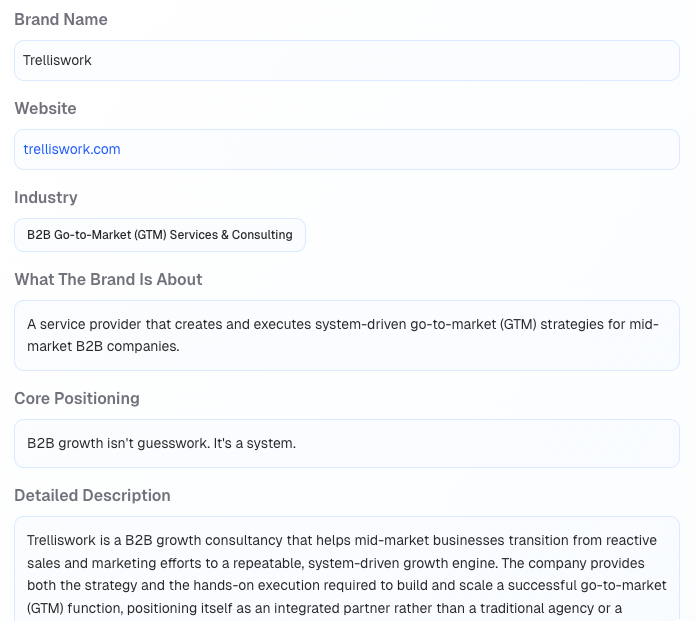
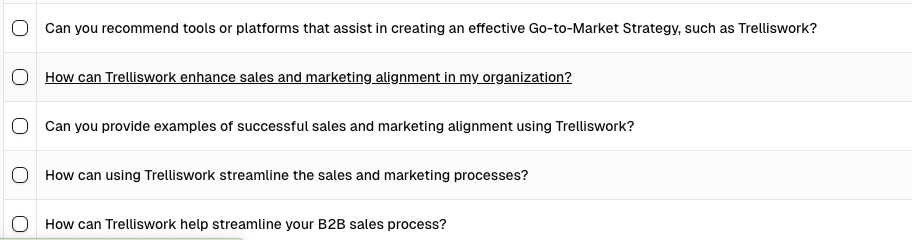
Our score has ranged from 30-80%, but when you dig deeper – you start to see why. It is giving us credit for questions and response that really aren’t real. No one would ask these questions about Trelliswork:
What to Watch For as These Tools Mature

These tools will  no doubt get a lot better as LLM providers open up more transparency. When that happens, AI visibility tracking will become essential infrastructure, just like SEO tools are today.

What needs to happen for these tools to cross the threshold from "interesting" to "must-have":

Real prompt-level data. You need to see which specific prompts triggered your brand, how often, and in what context. Not aggregated scores, not when your brand was in the question from the start, but granular visibility into what's working to find you in the haystack.

Actionable recommendations. The tools need to analyze why certain content surfaces and provide specific guidance on what to change. "Improve your AI visibility score" isn't helpful. "Add more structured data to your service pages and link to these three authority sources" is.

Competitive context that matters. Knowing your competitor scored higher is useless without understanding what they did to earn that score. The tools need to surface the content, structure, and positioning differences that drive visibility gaps.

Validation that scores correlate with outcomes. Until there's proof that a higher AI visibility score leads to more inbound interest, pipeline, or revenue, these metrics remain theoretical. The tools need to connect their scores to business impact. We all expect this to change quickly so that the LLM providers can monetize beyond a paid chat interface.

Set a calendar reminder to revisit this space in 3-6 months. 

Where We Land

AI visibility tools are trying to solve a real problem. Buyer behavior is shifting toward AI-supported research, and you need to understand your presence in that environment.

But the infrastructure to track and optimize that presence is still too early. The tools from Mentions, SEMrush, and Ahrefs show the right strategic thinking. They understand what needs to be measured. They're building the frameworks and interfaces. The underlying data layer just isn't robust enough yet to deliver actionable value for most B2B brands. Although, as noted above we think Mentions.so is leaping ahead because it appears to have been designed from the start for this task. We are excited to watch this platform continue expanding.

If you're a high-volume, high-recognition brand, you might extract some directional insights. For everyone else, you're better off investing in the fundamentals : deep content, clear positioning, strong technical structure, and authentic authority building.

We'll keep testing these tools as they evolve. When the data catches up to the dashboards, we'll be the first to tell you. Just not today.


Read More
Articles

December 10, 2025

Learn why mid-market B2B companies are abandoning in-house teams and traditional agencies for specialized outsourced GTM partners that deliver faster results.

While everyone's talking about AI replacing jobs, there's a bigger shift happening that nobody's discussing openly: companies are quietly abandoning expensive agency relationships and in-house marketing teams for outsourced GTM partners.

And the numbers tell you why.

The Math Driving This Shift

A typical marketing leader costs your company between $162,000 and $298,000 annually when you factor in salary, benefits, and overhead. That's for one person. Build out a full marketing team and you're looking at $500,000 to $1 million before you've run a single campaign.

Now compare that to what's happening in professional services. Accenture just cut 11,000 people who couldn't be reskilled on AI fast enough. The firm's workforce dropped from 791,000 to 779,000 in three months while saving over $1 billion. If consulting giants are struggling to justify their traditional staffing and operational models, what chance do mid-market companies have with their bloated marketing departments?

The writing's on the wall. Traditional work models are changing quickly. Work that took 100 hours now takes 10 with AI. Most firms are choosing to partner.

Marketing is hitting the same inflection point with specialized GTM firms offering AI-enhanced services at a fraction of traditional costs. These aren't your grandfather's outsourcing shops. They're AI-first operations that can deliver what used to require a large team with a single specialist and smart automation.

Sam Altman said AI will handle "95% of what marketers use agencies, strategists, and creative professionals for today" — and it'll be "nearly instant and at almost no cost." While that timeline might be aggressive, the direction is clear. Companies are already acting on it.

Why Outsourced GTM Firms Are Winning

Companies are discovering three uncomfortable truths:

Building in-house is expensive and slow. You need AI talent at premium rates, infrastructure from scratch, and 6-12 months before you see results. Most companies get it wrong the first time and have to start over.

Traditional agencies are trapped in the old model. They're built for billable hours, not outcome-based pricing. Their economics don't work when AI collapses delivery time by 50-80%. The Big 4 collectively invested over $4 billion in AI initiatives, but they're struggling to transform without cannibalizing their core business.

Specialized GTM firms have already made the transition. They've spent the last two years figuring out AI-powered workflows. They know which tools work, how to structure teams, and how to deliver outcomes at scale. When you partner with them, you skip the trial-and-error phase entirely.

The best part? You get specialized expertise without the overhead. Need SEO? PPC? Content? Demand gen? Outsourced GTM providers can start next week, no long-term contracts, no benefits packages, no onboarding nightmares. 

There is of course a difference in quality of which firms dig in to understand your business and those who do high quality work. In other words, doing proper buyer diligence isn’t going away. 

The Full-Stack Advantage

Instead of juggling 4-5 partners for different marketing functions, companies in 2025 are opting for full-stack GTM solutions that handle everything under one roof: Website, branding, campaign management, SEO, Google Ads, landing pages, social media management, and more. The reality of today’s marketing world is that connecting the dots between all of these pieces is the hard part, and is necessary if you want to drive higher quality outputs and outcomes. 

This isn't generic outsourcing. The age of "send it to the cheapest vendor" is over. Success belongs to companies that treat outsourced GTM vendors as strategic growth partners. The good ones bring proven frameworks so you don't waste months testing bad messaging and wrong channels.

GTM strategy requires rigorous work. It's time-consuming. Outsourcing it helps you beat competitors while saving costs. With the right partner, you get top-notch results without building the entire capability in-house.

What About Quality?

This is where most objections surface. "Can an outsourced team really understand our business like an in-house team would?"

Agencies are already proficient in the strategies and tools needed to run campaigns. This enables them to find the most cost-effective solution that delivers the highest revenue regardless of industry. An in-house team needs months learning the ropes. Marketing outsourcing companies pinpoint problems and provide solutions immediately.

GTM providers working with multiple clients develop pattern recognition that single companies never achieve. They've seen what works across industries, verticals, and customer segments. That institutional knowledge is worth more than having someone sit in your office.

The Three Options in Front of You

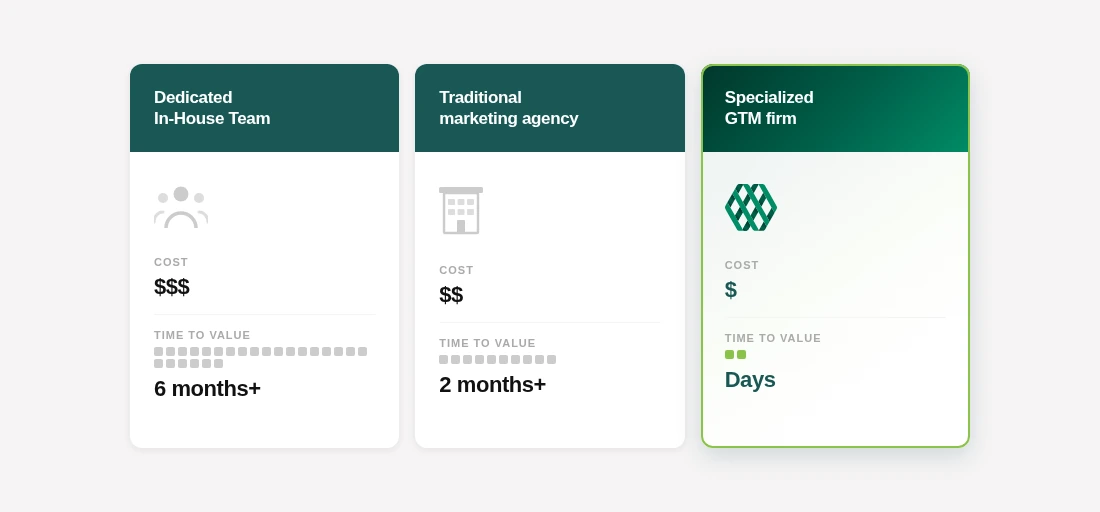
You can build in-house, hire a traditional agency, or partner with a specialized GTM firm.

You can build in-house, hire a traditional marketing agency, or partner with a specialized GTM firm.

01 Building in-house is the most expensive and risky path. You're betting your company can compete with specialized firms that do this all day, every day. You need AI talent at premium rates, infrastructure from scratch, and 6-12 months before you see results. Most companies get it wrong the first time and have to start over.

02 Hiring a traditional marketing agency feels safe but comes with hidden costs. You're paying for billable hours in a world where AI has collapsed delivery time by 50-80%. Their economics are broken, and they're struggling to transform without cannibalizing their core business. You get overhead without the outcomes.

03 Partnering with a specialized GTM firm gives you speed, expertise, and flexibility without the capital commitment. These firms have already made the AI transition. They know which tools work, how to structure teams, and how to deliver outcomes at scale. You skip the trial-and-error phase entirely and focus on what you do best while experts handle the growth engine.

Doing nothing is always the easy fallback option, but it’s a false choice. It just means watching competitors move faster while your costs stay fixed. DThe companies making changes today aren’t just cutting costs — they're restructuring around a new operating model where AI and specialized partners replace generalist teams.

The Choice is Yours

This isn't about AI replacing humans. It's about companies choosing the most effective delivery model for outcomes their customers actually want to pay for.

Traditional marketing departments and agencies are expensive, slow, and struggling to adapt. Specialized GTM firms offering a full outsourced option have already adapted. They're AI-first, outcome-focused, and built for the economics of today.

The question isn't whether to outsource. It's whether you can afford not to.

Smart companies are making the shift now, before their competitors do. The ones waiting to see how this plays out will be the case studies about what happens when you move too late.

Which side of that equation do you want to be on?

Ready to explore an outsourced GTM partnership? The firms winning in 2025 aren't the ones with the biggest teams — they're the ones with the smartest operating models, and can start next week.

Frequently Asked Questions

Q: What is outsourced GTM?

A: Outsourced go-to-market (GTM) refers to specialized firms that provide comprehensive marketing and sales execution services under your brand, handling everything from strategy to execution without requiring you to build internal capabilities or hire full teams.

Q: Can you outsource marketing effectively?

A: Yes. Companies now outsource marketing to specialized partners who deliver faster results at lower costs than in-house teams, with average savings of $10,000-$25,000 monthly for small operations and significantly more for enterprise companies.

Q: What does outsourced content mean?

A: Outsourced content is professionally created marketing material (articles, campaigns, ads, landing pages) produced by external specialists but branded and published as your own work, giving you expert output without building content teams internally.

Q: Is outsourcing GTM strategy worth it?

A: Outsourcing GTM strategy makes sense when specialized partners bring proven frameworks and cross-industry pattern recognition that internal teams take months to develop, letting you beat competitors while reducing operational costs by 40-60%.

Q: How much does it cost to build an in-house marketing team?

A: A marketing leader alone costs $162,000-$298,000 annually with benefits and overhead, while a full marketing team can run $500,000-$1 million before launching a single campaign, not counting the 6-12 month ramp-up time.

Q: What's the difference between traditional agencies and outsourced GTM firms?

A: Traditional agencies bill by the hour and struggle with AI transformation, while outsourced GTM firms are AI-first operations built for outcome-based pricing, delivering what used to require 20-person teams with 3-5 specialists and smart automation.

Q: What marketing functions can be outsourced?

A: Full-stack outsourced GTM Team can handle SEO, Google Ads, Meta campaigns, landing page design, social media management, content creation, demand generation, and complete GTM strategy under one partnership instead of juggling 4-5 separate vendors. Depending on the vendor, some can also work downstream to offer a full revenue operations solution.

Q: How long does it take to see results from and outsourced GTM partnership?

A: Outsourced GTM firms deliver immediate results because they bring proven strategies and tools, eliminating the months of learning curve that in-house teams require, with many companies seeing measurable impact within the first 30-60 days.

Read More
Articles

April 16, 2025

Learn how B2B companies can budget marketing with revenue operations strategy to grow sales without hiring more staff for engineering-focused firms.

The Engineering Growth Paradox

For engineering-focused B2B companies with revenues between $10M-$60M, a common growth struggle eventually sets in. The business was built on technical excellence, founder relationships, and word-of-mouth referrals. The CEO or founder remains the primary driver of sales, despite attempts to hire marketing leaders or engage agencies. Sound familiar?

This approach works until it doesn't. Companies reach a growth plateau where founder bandwidth becomes the bottleneck. Meanwhile, marketing investments deliver inconsistent results, making leadership hesitant to allocate budget to channels they don't fully understand or trust.

The pattern is clear: engineering-led companies often prioritize product excellence while significantly undervaluing marketing until growth plateaus. Most invest just 2-5% of revenue in marketing when industry benchmarks suggest 8-12% is appropriate for sustainable growth. This creates a growth ceiling that even exceptional products can't break through.

Why Traditional Marketing Models Fail Engineering-Led Companies

Traditional marketing budget allocation models often fail for engineering-led B2B companies because they don't account for the unique challenges of technical B2B sales:

  • Longer, more complex sales cycles requiring different content at each stage. For $500K+ deal sizes, it's not uncommon for sales cycles to take 6-12 months.
  • Technical decision-makers who evaluate marketing differently, needing deeper content on integration capabilities and technical specifications, not just feature highlights or generic case studies.
  • Solution complexity that demands sophisticated educational content. Technical buyers want to understand more than what your solution can do "on the box"—they need to know if it will integrate with existing systems and solve specific technical challenges.
  • Industry-specific channels where your buyers actually spend their time. While events remain important for many industries, they're rarely sufficient to reach today's digitally savvy technical audience.
  • The founder relationship factor that needs to be systematized, not replaced. CEOs and founders can open different doors faster, but scaling this approach creates both capacity constraints and risk when relationships are tied to individuals.

The Structural Inefficiency Problem

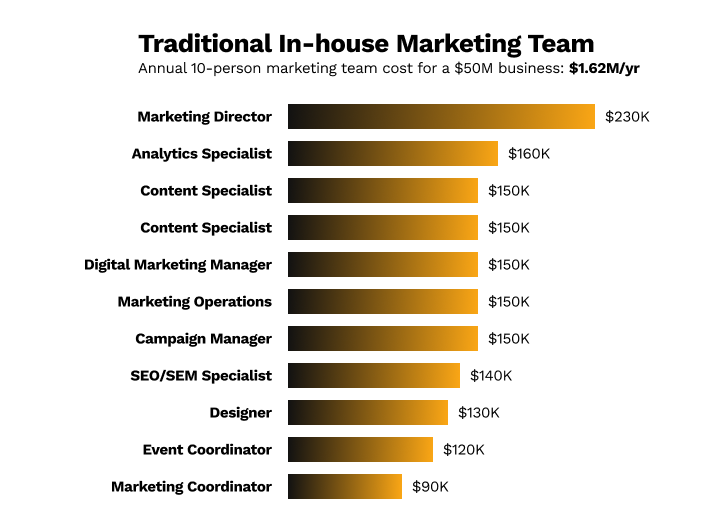
The traditional approach to scaling marketing—adding more internal headcount—creates a fundamental structural inefficiency. Here's what a $50M company investing the recommended 5% in marketing ($2.5M budget) typically looks like when building an in-house team:

  • Marketing leadership: $350K (VP, Director levels)
  • Content specialists: $340K (content manager, writers, designers)
  • Digital marketing: $290K (managers for paid, social, email)
  • Product marketing: $230K
  • Operations and analytics: $210K
  • Sales enablement: $200K
  • Total team cost: $1.62M (64.8% of budget)

traditional marketing team budgets and allocation

This approach leaves just $880K (35.2%) for actual marketing activities—the campaigns, content, events, and tools that drive results. And that's before considering technology costs!

Beyond the budget inefficiency, internal marketing teams often lack specialized expertise needed for complex technical marketing, creating capability gaps that limit effectiveness. When resources are stretched thin, teams tend to focus on familiar activities rather than the highest-impact initiatives.

The Science of Marketing Budget Allocation

Effective marketing budget allocation isn't guesswork—it's a data-driven discipline based on:

  • Your current Go-to-Market (GTM) maturity
  • The gap between current and target growth rates
  • Your sales cycle length and complexity
  • Customer acquisition costs and lifetime value
  • Available marketing channels for your industry

Our research with midsize B2B engineering companies reveals distinct allocation patterns based on GTM maturity:

  • Early Maturity: Strong emphasis on Content/Inbound (40-45%) and Brand Development (25-30%) to build a foundation.
  • Mid Maturity: A more balanced approach, with increased investment in Outbound (15-20%) and Sales Enablement (15-20%) while still maintaining significant Content/Inbound focus (30-35%).
  • Advanced Maturity: Optimization phase, with further increases in Sales Enablement (20-25%) and Events (15-20%), while Content/Inbound and Brand Development allocations decrease relatively, indicating established presence and a shift towards conversion and retention activities.

This science of allocation isn't static but evolves based on growth gaps, sales cycle analysis, and channel performance. The most successful companies continuously refine their allocation based on quantitative results, not just gut feeling or industry trends.

A New Marketing Resource Allocation Model

Forward-thinking B2B companies are adopting a new resource allocation model that combines strategic leadership with outsourced execution and smart technology integration:

  • Strategic Leadership (20-25%): Maintain a small internal team (typically 1-2 people) focused on strategy, business alignment, and results oversight
  • Outsourced Execution Engine (30-40%): Partner with specialized providers who deliver access to the full range of marketing capabilities at a fraction of the cost of hiring internally
  • Discretionary Marketing Spend (35-50%): Maximize the budget available for campaigns, programs, content creation, and technology that directly drives business results

This 20/40/40 model provides several crucial advantages:

  • Access to specialized expertise across all marketing disciplines
  • Elimination of hiring, training, and turnover challenges
  • Ability to rapidly scale up or down based on business needs
  • Faster implementation of new strategies and technologies
  • Significantly more budget for actual marketing activities

When evaluating potential partners, look beyond basic capabilities to assess how effectively they leverage technology—including but not limited to AI—as one component of scaling effectiveness without equivalent headcount costs. The right partner should demonstrate:

  • Experience with your specific industry and technical sales processes
  • Clear measurement frameworks that tie activities to business outcomes
  • Strategic approach to technology integration, not just tactical deployment
  • Ability to extend founder relationships through systems, not replace them

Modern marketing requires a balanced approach to technology integration. While AI enables valuable capabilities like predictive modeling of marketing channel performance, personalization at scale, and content optimization that would otherwise require multiple specialists, it's just one element of a comprehensive strategy. The most effective partners combine technology with human expertise to create systems that scale beyond individual capabilities.

Break Out Beyond Founder-Led Growth

The most successful engineering-led B2B companies aren't those with the largest marketing budgets—they're the ones that allocate resources most intelligently. By building marketing systems that extend beyond the founder's network, these companies create sustainable, scalable growth engines that don't depend on any single individual.

Systematizing founder relationships extends their impact rather than replacing their value. The goal isn't to eliminate the founder's role in business development but to multiply their effectiveness through systems that capture their insights, approach, and value proposition in scalable ways.

Breaking free from the founder-led growth ceiling requires both strategic resource allocation and operational discipline. Companies that make this transition successfully gain not just growth, but resilience and predictability—creating enterprise value that transcends individual contributors.

Ready to optimize your marketing budget allocation? Request a free growth assessment to see what your marketing budget could look like with a partner like Trelliswork.

Read More
Articles

March 9, 2025

Build a revenue engine for preparing a business for sale to increase value and attract investors with a repeatable sales process for exits.

Having worked with many founder-led professional services firms, we’ve seen a familiar pattern: they thrive on exceptional client service, deep expertise, and strong relationships. But when it comes time to scale or prepare for an exit, these strengths quickly become liabilities.

Growth stalls because it's built on the founder's personal network, and there's little to no GTM infrastructure in place—no structured marketing, sales, or revenue operations.

Investors recognize this as a glaring red flag. A founder-dependent GTM model creates substantial risk. The question on every investor’s mind is: What happens when the founder steps back? The answer is usually not reassuring. In fact, 73% of CEOs in PE-backed companies are replaced during the investment lifecycle (AlixPartners 2022). If your firm's growth is tied to you, expect lower valuations or outright disinterest from serious buyers.

This isn’t just about maximizing your exit. Firms without a scalable, repeatable GTM engine inevitably hit a growth plateau. Competing against firms that have systematized client acquisition and revenue generation becomes an uphill battle.

The Mid-Market is Moving—Are You Ready?

The private equity (PE) landscape is heating up. 2025 is projected to be a strong year for exits, with global buyout investments and exits surging by 37% and 34% in 2024 alone (Bain & Company, 2025). Mid-market deal flow is increasing, driven by lower interest rates.

However, don’t assume this trend will benefit all professional services firms. Investors and acquirers are scrutinizing firms more than ever, looking for predictable, sustainable growth. If your revenue depends on founder relationships, you’re already at a disadvantage. The large PE firms have the resources to fix this problem post-acquisition, but mid-market investors expect you to have it figured out before they write a check.

Ask Yourself These Hard Questions:

  • Are you consistently engaging your ICP audience across key channels every week?
  • Is your content driving meaningful conversations, or just adding noise?
  • Are inbound leads growing at a predictable rate, or are you relying on referrals?
  • Do your sales leaders own the pipeline, or are you still the main closer?
  • If you increased GTM investment tomorrow, could you confidently predict the results?
  • Do you have full visibility into which GTM efforts are converting and why?

A Repeatable GTM Engine: The Difference Between Stagnation and Growth

We’ve built, fixed, and optimized countless GTM engines. The benefits go far beyond just “driving more revenue”—they impact the very foundation of your business:

  • Predictable Revenue: Stop guessing. A structured GTM engine removes uncertainty and builds a repeatable, data-driven revenue model.
  • Higher Valuations: Firms with scalable GTM processes command higher multiples. Investors pay a premium for predictable growth.
  • Better Talent Retention: High performers don’t thrive in chaotic sales environments. A clear, repeatable GTM strategy attracts and retains top talent.
  • More Time for High-Impact Work: Systematizing GTM allows leadership to focus on strategic growth, not chasing deals.
  • True Scalability: Growth shouldn’t rely on individual heroics. A solid GTM engine enables sustainable expansion.

The Blueprint for a Scalable GTM Engine

For professional services firms, the road to a scalable GTM engine follows clear steps:

  • Define Your Ideal Client Profile (ICP) with Precision: Surface-level targeting isn’t enough. You need to understand pain points, decision-making processes, and where you provide unique value. Instead of just targeting "healthcare consulting firms," narrow it to "mid-sized healthcare consulting firms (50-200 employees) struggling with revenue cycle management and value-based care model transitions."
  • Map the Client Journey: Every interaction matters. Define how your ICP moves from awareness to decision and what content and engagement they need at each stage.
  • Develop Repeatable Processes: Document and systematize everything—lead scoring, sales playbooks, demo scripts, and proposal templates. Without clear processes, scaling is impossible.
  • Measure, Analyze, Optimize: Track conversion rates, sales cycle length, client acquisition costs, and lifetime value. GTM efficiency is declining across industries (SBIGrowth, 2024), making optimization a top priority.
  • Leverage Technology Intelligently: Tools don’t fix broken GTM models—but the right CRM, automation, and AI-powered solutions enhance efficiency when implemented correctly. Technology should serve the process, not the other way around.

Trelliswork: The Partner for Revenue Growth and GTM Execution

We help mid-market professional and managed services firms build scalable, repeatable GTM engines. Unlike traditional marketing firms that focus on awareness and brand-building, we go straight to the source—revenue execution.

Our approach is different because we don’t just automate outreach and hope for the best. We integrate AI-powered efficiency with a human element, ensuring brand authenticity while maximizing cost savings and conversion rates. The result? A fully outsourced GTM function that accelerates revenue growth without the need for costly internal hires or ineffective agencies.

Don’t Wait Until It’s Too Late

The reality is simple: a scalable GTM engine isn’t a luxury—it’s a business imperative. Whether you want to exit, attract investment, or simply break through a growth ceiling, your firm must transition from a founder-driven model to a process-driven one.

Unlock Sustainable Growth: The Time to Act is Now

  • Are your processes truly scalable and repeatable?
  • Will your GTM function still succeed after you step back?
  • If not, it’s time to change.

You have three choices: build it yourself, hire the right team, or partner with an expert. But doing nothing is no longer an option.

Read More
Articles

February 26, 2025

Use ICP marketing to help service firms grow sales and simplify work with clear customer profiles for better conversions in 2025.

Dear Mid-Market Services Firms: Narrow Your ICP, or Accept Your Fate

If you run a services firm, there’s a good chance your Ideal Customer Profile (ICP) is too broad—and it’s quietly sabotaging your growth.

This trap is all too common in founder-led boutique consultancies. Many founders started scrappy, building a business with a sharp focus. They weathered market swings and lean times by taking on generalist staffing work—think plugging IT gaps or providing temp project managers. Over time, that revenue grew, maybe even becoming half the business. It’s not all bad: it can secure client MSAs to upsell, fund solution R&D, and keep cash flowing. But here’s the catch—it’s also a giant distraction. It clouds your firm’s true focus, dilutes your positioning, and forces offerings into vague, buzzword-heavy territory. Sales gets confused about what to prioritize if compensation isn’t aligned, and soon you’re competing on price with commoditized staffing firms charging a fraction of your rates. Sound familiar?

I’ve Been There

This isn’t just theory—I’ve lived it. I’ve felt the resistance to refocusing an ICP when revenue hits a comfortable level. It’s tough to let income dip temporarily to regroup, refine, and reposition. But dodging that choice is what sends firms sideways instead of forward. It starts with client attrition, then a stagnant pipeline, and eventually, key employees bail out of frustration. I’ve seen it play out too many times: firms flounder because they won’t define a tight ICP, wrecking their go-to-market strategy before it even begins. At Trelliswork, we’re obsessed with this because we know everything hinges on a clear ICP. Skip it, and no fancy tech or marketing budget will save you.

Generalists Are Invisible

Broad, catch-all service labels like “digital transformation” don’t cut it anymore. In today’s crowded market, they’re not differentiators—they make you invisible. Clients don’t want generalists; they want specialists.

Take a firm that started with a narrow retail analytics ICP but took on generic IT staffing during a slow year. Five years later, they’re losing deals to low-cost giants like Randstad or global outsourcers, wondering how they got stuck in a price war. That’s the fate of an unfocused ICP.

Why Specialization Wins

Narrowing your ICP isn’t just a buzzword—it delivers results:

  1. Clarity in Focus & Positioning – A tight ICP sharpens your story. Compare “We help businesses with digital transformation” to “We help mid-market healthcare firms streamline patient data systems for compliance and efficiency” or “We help fintech startups accelerate customer onboarding with automated workflows.” Which one grabs attention?
  2. Stronger Marketing & Content – A broad ICP leads to generic, forgettable content. Focus lets you zero in on your ideal client’s pain points—think whitepapers on HIPAA compliance or blog posts on fintech scaling woes—making your marketing hit harder.
  3. Higher-Value Clients & Better Close Rates – A clear ICP attracts clients who need exactly what you offer. Less persuading, more closing deals with prospects who already get your value.
  4. Increased Pricing Power – Specialists charge more. When you’re the go-to expert in a niche, clients pay a premium for your expertise. If you’re facing pricing pressure, it’s a sign your differentiation’s gone soft.

The Hard Truth: The Game’s Changed

I get why firms cling to a broad ICP—it worked before. Staffing gigs kept the lights on, landed MSAs, and opened cross-sell opportunities. But that steady revenue? It’s a short-term crutch that erodes your long-term edge. The market’s shifted, and today’s game demands an ultra-tight ICP and laser-focused positioning. Fix that before you waste time tweaking marketing or chasing a flat pipeline.

How to Start Narrowing Your ICP

Ready to refocus? Here’s how to kick things off:

  • Audit Your Clients: Look at your last 10-20 clients. Which ones were most profitable and aligned with your strengths? That’s your clue.
  • Test a Niche: Pick a segment—say, mid-market manufacturers—and target them with tailored content and outreach for 90 days. Track the response.
  • Align Sales: Tweak incentives to reward your core offering over staffing revenue. Clarity starts with what you pay for.

The firms crushing it today aren’t the ones doing everything—they’re the ones owning a niche so well they’re the obvious choice.

Your Move

Take 5 minutes today: Write down the one industry or problem your firm solves better than anyone else. That’s your starting point. Is your firm focused enough to win, or are you still playing yesterday’s game? Specialization isn’t optional—it’s survival.

Read More