


The gaze of AI-energized VC is turning toward the worthy goal of building an agentic marketing stack, and the money is getting serious. Earlier this summer Gradial raised a 65 million dollar Series C, bringing its total raised to roughly 120 million. Then Ploy came out of stealth with a 27 million dollar seed founded by Bryant Chou, co-founder and founding CTO of Webflow. His pitch is the website as the hub of the whole growth system, optimizing itself and running campaigns in the background, continuously.
The thesis underneath these platforms is easy to agree with. A campaign that takes a week to imagine takes a quarter to ship, and then another quarter to run. Every page, email, ad, and iteration has to crawl through agencies, tickets, reviews, and tools built for a slower less integrated world. That bottleneck is still real for just about everyone.
We see this production-line problem every day when we meet new clients at Trelliswork and we are not working with giants like T-Mobile, Prudential, or AWS, all Gradial references BTW. Our clients, who range from 3 million to 550 million in revenue, have the identical problem just with a different scale. Linking all of these systems together to produce and run a campaign gets ugly fast, especially when you have multiple agencies in play next to internal teams that are stretched thin or barely staffed.
These new platforms orchestrate a series of processes that mimic a traditional stack. They invoke specialized agents and tune the output against the inputs you give them and the signal that comes back. A rules engine encodes brand, accessibility, and governance. A design system gets applied by default. GEO work ships different angles automatically and watches for what lands. Ploy runs the same logic through the website, syncing copy, campaigns, and CRM data on its own. Executing this pattern consistently and at high quality has always been doable. You just needed an army of agencies and tooling on hand. And time. Lots of it.
Taste comes full circle
A once cool word in Silicon Valley circles, now generally avoided: Taste. Greg Brockman has referred to “taste” as a new core skill. Paul Graham says it gets more important, not less. Dan Pink told a room of art school graduates at their commencement that “taste” is their killer app. You make things, and you find the courage to say no. Kyle Lacy put it best in an essay: "You cannot buy taste. You cannot template it. You cannot prompt it into existence. When production gets cheap, conviction gets rare."
We agree with all of it. The argument is not whether taste matters. The argument is what it looks like once you actually run one of these systems.
"You cannot buy taste. You cannot template it. You cannot prompt it into existence. When production gets cheap, conviction gets rare." - Kyle Lacy
What it looks like in the trenches
We run a very similar setup at Trelliswork. Standard workflows, off-the-shelf tooling, MCP/API direct for everything, and skills upon skills. Functionally it is what Gradial built, except we did not need nine figures to get there, and we have been profitable since day one. A few first principles got us here, and we still hold them.
- Humans love to tinker and are never fully satisfied. Treat that as a feature. Aim it at the output as deliberate taste and the work gets sharper, and unique. It's the anti-AI slop factor.
- You cannot outrun or out-invest the innovation cycle from platforms like Gradial. Build on top of it, keep abstracting upward, and treat every part of your stack as always under review.
- DTC can run close to 100 percent lights out because it can focus on one tight segment. B2B tends to be less focused, has a lot more cooks in the kitchen and tends to need more hands. Know which one you are.
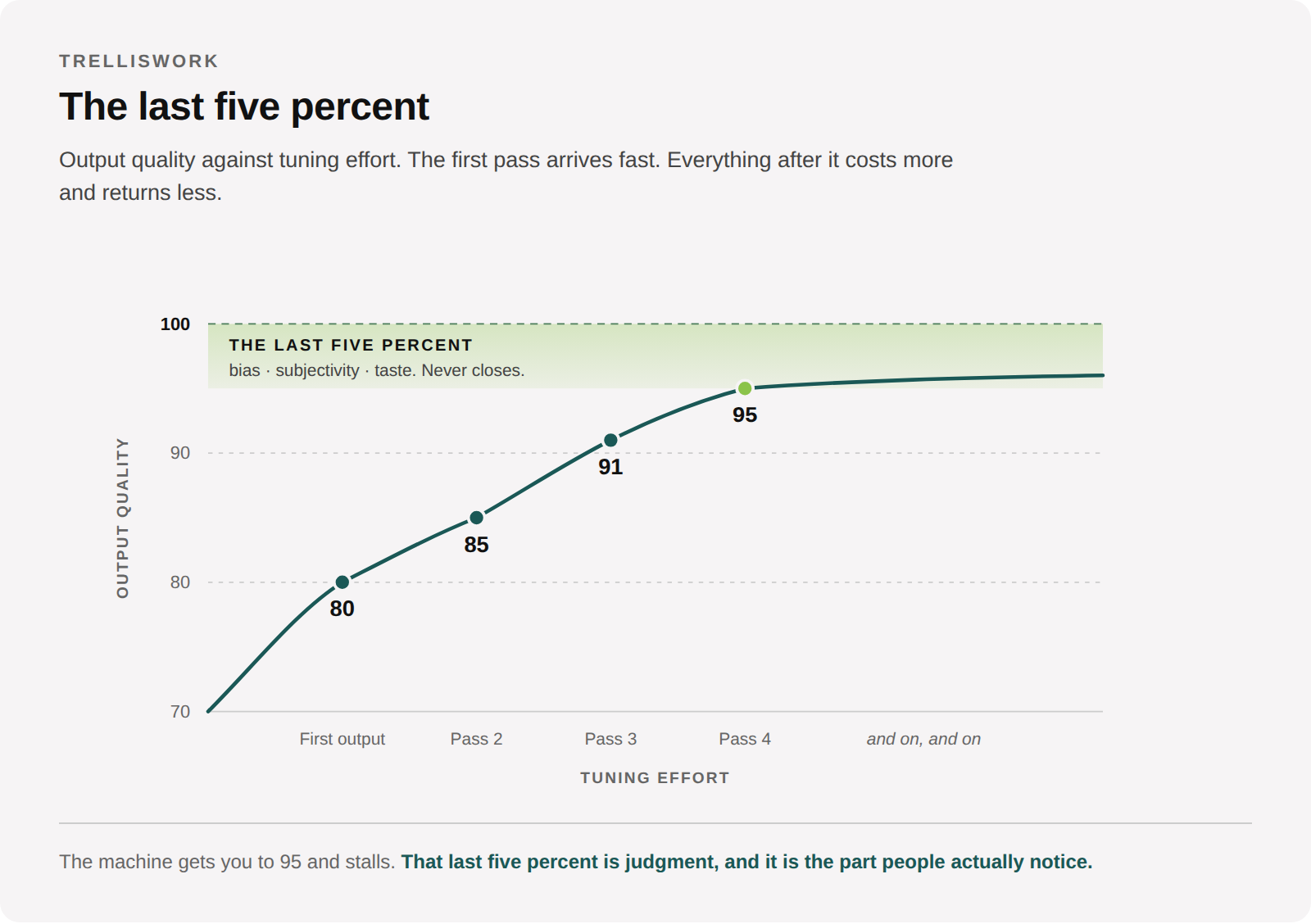
Ask anyone who has stood up one of these systems. On the surface it is incredible. Then the first output lands and it is 80 percent there. You tune it to 85. Then 91. Then 95. That last 5 percent is bias, subjectivity, taste. It stays hard to automate, and it is the part people notice. You also have completely different quality bars for different audiences, markets, and clients so the level of human tinkering with output can vary significantly.
The hard part is where services will still thrive.
Full lights-out is not a near-term reality for most companies, for two reasons.
First, focus. You can preach ICP all day, but most teams are not focused enough, especially scrappy, opportunistic founders willing to try every angle. Point a machine at an unclear message and you get more of an unclear message, faster.
Second, the work itself. Connecting the systems, cleaning the data, encoding the brand, refining the automation, deciding what is good enough to ship. For a focused company that is a decent effort. For the mid-market it is a mountain. Most buyers forget that part in the demo.
Platform companies sell software, not the work, and the good ones say so out loud. Gradial's delivery partner is Perficient. Gradial describes that role as operationalizing the platform inside complex enterprise environments, designing the architecture, managing the change, and bringing vertical depth across healthcare, financial services, retail, and automotive. Perficient ran the platform on their own marketing operation before ever taking it to a client, so the delivery team knows it from the inside.
That is the right model. It is also the best description of our job I have read all year, written by somebody else, about a company far larger than ours. Someone has to operationalize the capability. At the top of the market that someone is Perficient. Below it, the list gets short fast.
That is a services job, and it is a hard one.
Integration of all the signals to continually optimize and reinforce makes for amazing vision, even better slideware. Enterprises have a lot of these signal sources either from an army of vendors or software stacks already in place. Mid-market has significantly less, and sub-midmarket virtually none. The effort to integrate or harness these signals to make the platform work will take serious work.
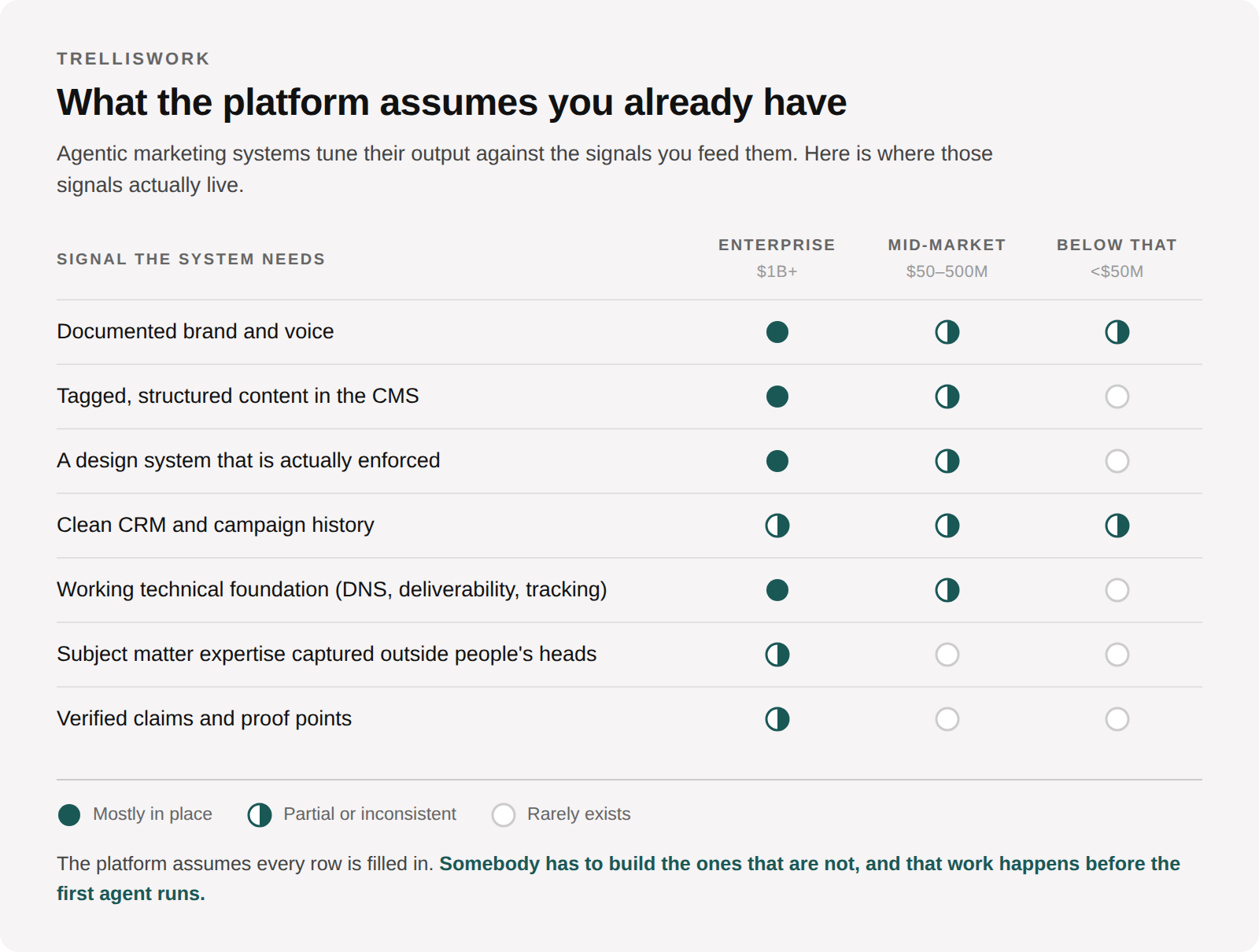
That gap is where managed services providers and agencies like Trelliswork thrive. The platform hands you an engine. Someone still has to wire it in, aim it, and adjust the output. This isn’t a defense, it’s just a realistic view from the trenches supporting clients who don’t have billion dollar marketing budgets.
Prepare to keep a human at the controls (at least one)
We love this space. We applaud the platforms because one day we will be integrating them for our clients. I will take the bet that even once the machine runs clean, there will always be a few operators at the controls injecting taste, and clients looking at the output saying nah, not good enough, try again. As they should.


