Strategy
What an AI-Native Marketing Organization Is

The phrase is having a moment. Could be all the venture capital flowing there, or that it seems like an obvious place in the enterprise where a lot of stuff can be generated quickly and is chronically underfunded.
Every platform selling into enterprise marketing has a version of it, there are four or five names for the same idea. Agentic marketing operations. A marketing system of work. An execution layer. A marketing harness. Take your pick.
The labels all tend to focus on large marketing organizations with a small army of people in them, or perhaps a large army if you count all the agencies attached. You also will likely find a martech stack with a decade of investment behind it, and a big budget line for transformation.
Most companies don't have that luxury. Our clients range from a few million in revenue to 550 million with marketing teams ranging from zero to ten people, but the opportunity still applies to them.
Three things it is not
An AI-native marketing organization is not a tool stack. Everyone already uses AI. Your team is using it right now, in six different ways, none of them written down. That is not an AI-native organization, that is six people with the same LLM subscription, and the inconsistency is the problem rather than the absence of tools.
It is not an org chart either. Nobody becomes AI-native by hiring a Head of AI or by putting agents on a slide where headcount used to be.
And it is not a purchase. The platforms are real and they work, but they also arrive expecting inputs that likely don't exist.
What it actually is
An AI-native marketing organization is one where the things that used to live in people's heads have been written down in a form a machine can act on quickly and consistently, with minimal revision, and that keeps improving as feedback comes back in.
What your experts know, how your company sounds, and what bad looks like.
Yes, you can include technical components like an orchestration layer, AI models, third-party system integrations, data repositories, collaboration surfaces, and harnesses. All of that makes the machine run more efficiently and more consistently, but none of it works without the following elements:
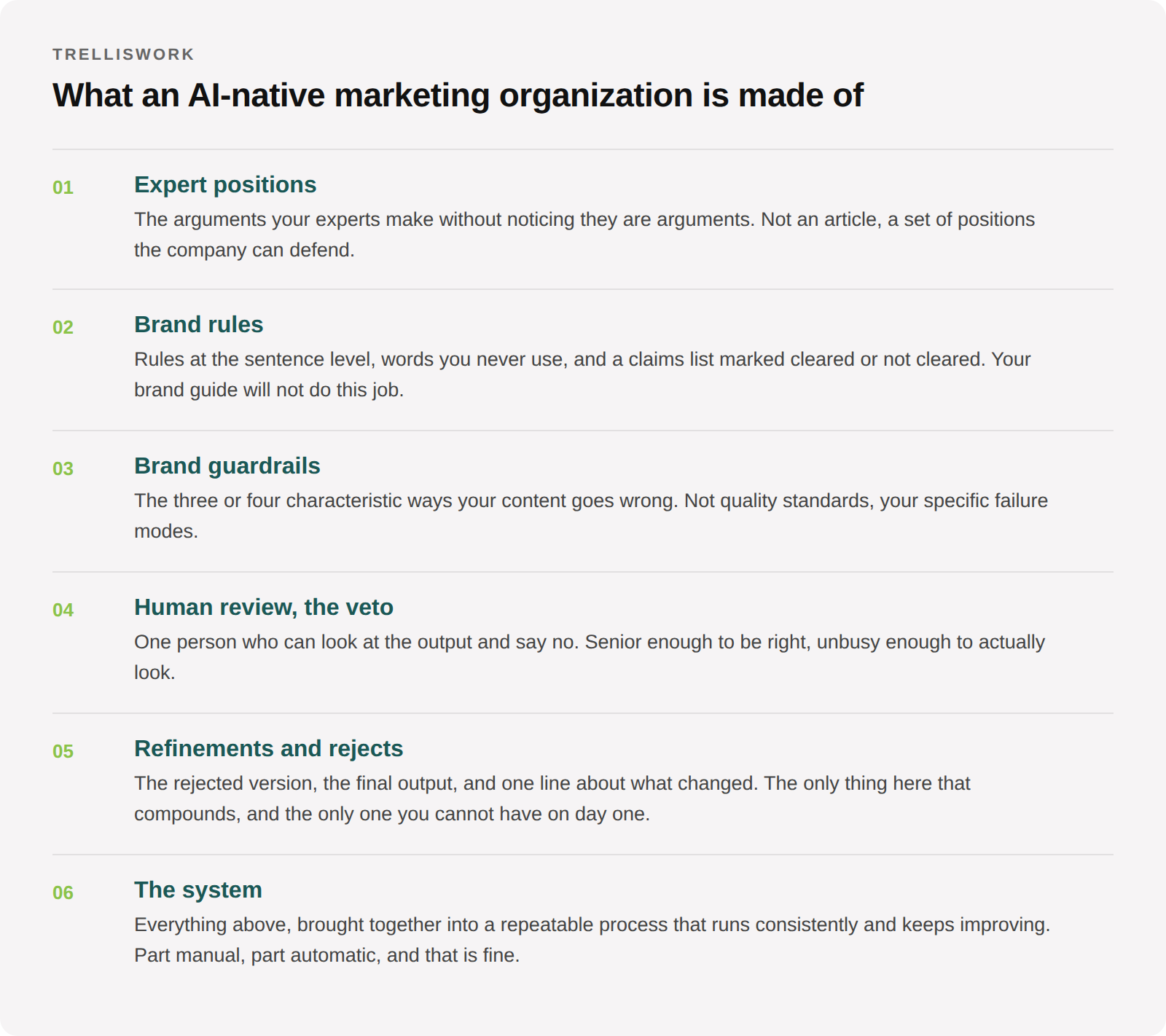
Expert positions
This isn’t a survey or a content questionnaire. These are the arguments your expert(s) make without noticing they are arguments, like the aside about why a competitor's approach falls apart at scale, or the thing they say to every prospect in the second meeting. Those are positions your company can defend, and most companies have never written them down.
The output of this stage is not an article, it is a set of positions.
Brand rules
You probably have a brand and style guide but it's more than that.
Brand guides are created for humans and they say things like "confident but approachable," which a person can act on, but a machine cannot. What a machine needs are rules at the sentence level, a list of words you never use, and a claims list with each claim marked cleared or not cleared for use.
Brand guardrails
A guardrail is not a quality standard, it is a specific failure mode of your specific company. Every company's content goes wrong in three or four characteristic ways. Yours might list features when it should be making an argument, or reach for a claim that the legal department never cleared. You already know what yours are, because you have watched them happen or realized the consequences of ignoring them.
Write those down so the machine can stay inside them.
Human review, A.K.A. the veto
One person should be able to look at the output from your team or your system and say no.
The requirement is harder than it sounds, because that person needs two things at once. Senior enough to be right about what is not good enough, and unbusy enough to actually look. Most teams have the first and not the second, and that is exactly how output drifts for six weeks before anybody notices.
Refinements and rejects
Every time somebody rejects a draft there is a reason. Usually it gets declared in a Slack thread and evaporates by Thursday, because the reviewer fixes it, ships it, and the information goes with it.
Keep it instead. The version that got killed, the version that printed, and a few lines about what changed. Nothing fancy, just a folder.
Examples of what you rejected, and why, will teach a system faster than any description of what you want. That file is the only thing here that compounds, and it is also the only one you cannot have on day one. A brand can be written down in a week and positions can be pulled out of an expert in a month, but a useful pile of rejected work takes a year of actually rejecting things and writing down why.
Once you have those, it's time to scale it up.
The system
Once you have the elements above you can bring them together, and this is where the idea of the system starts to materialize for most people.
It can be assembled piecemeal, part manual and part automatic, and that is fine for most. What matters is a repeatable process that runs consistently and keeps improving. As the manual steps come out the bottlenecks go with them, and what opens up is a level of scale you could never have staffed for. Personalization by segment, campaigns running in parallel, and testing at a frequency that used to be out of reach.
Everyone wants to talk about this step, because we love software that looks like a silver bullet, but the elements that make this work are everything before it.
Where it goes
The real secret sauce in all this is continuous improvement.
The system stops making mistakes you already corrected, not because the model got better but because your record of refinements did.
Speed shows up after that and work moves faster because fewer decisions get made twice. The brief does not get re-argued, the voice does not get re-litigated, and what used to be a week of back and forth over the same old points becomes a quick morning of discussion.
Then comes the second loop, the one that runs outside the building. What got read, what got cited in an answer engine, what a buyer repeated back to you on a call. Feed that in and the system stops guessing what to make next, because signals start the work instead of a person staring at a content calendar on a Monday.
What the loop will not do
The loop makes execution better, but it does not tell you what to say.
Every improvement above comes from a pattern in your own history, which works well for how you sound and what you have already rejected. It does not work for deciding which argument matters this quarter, because that answer is not in your history, it is free-flowing in the market around you.
So the marketer’s job changes shape, focused less on production, and more on what to point the machine at.
That job is smaller than the one most marketing teams have now, but it is harder. The machine will execute whatever you aim it at, quickly and at volume, and it will never ask whether you picked the right thing. A bad call scales just as well as a good one.
Start with the inputs, since they are critical but know what you are building toward. It is not an empty marketing department, it is a smaller group of people making fewer decisions that are more strategic and more impactful versus a bunch of smaller tactical production choices.
Frequently asked questions
Is an AI-native marketing organization the same as agentic marketing operations?
Mostly, yes. Agentic marketing operations, a marketing system of work, an execution layer, and a marketing harness are different vendors' names for the same idea. The distinction that matters is not the label, it is that almost every version of it assumes a marketing organization with hundreds of people and a budget line for transformation.
Do you have to buy a platform to become an AI-native marketing organization?
No. The platforms are real and they work, and they also arrive expecting inputs that most companies have not created yet. Buying one before your positions, brand rules and guardrails exist gets you faster output of the wrong thing.
Can we start with the automation and add the rest later?
You can, and it is the most common way this stalls. The elements that make the system work are all the ones that come before it, so automating first means scaling whatever inconsistency you already had. Scale amplifies what is there rather than fixing it.
How long does it take?
Brand rules can be written down in about a week and expert positions can be pulled out of someone in a month. The pile of rejected work that teaches the system what you actually want takes roughly a year, because it only grows when you reject things and write down why.
Is our brand and style guide enough for this?
It is the starting point, not the finish. Brand guides are created for humans and say things like "confident but approachable," which a person can act on and a machine cannot. On top of it you need rules at the sentence level, a list of words you never use, and a claims list with each claim marked cleared or not cleared for use.
Why keep rejected drafts instead of just fixing them and moving on?
Because the rejection contains the reason, and the reason is the part that teaches. Keeping the version that got killed, the version that printed, and a few lines about what changed will train a system faster than any description of what you want. It is also the only asset here that compounds.
Does an AI-native marketing organization mean a smaller marketing team?
Probably smaller, and definitely different. Less production work and more deciding what to point the machine at, which means fewer decisions carrying a lot more weight. The system will execute whatever you aim it at without ever asking whether you picked the right thing, so a bad call scales just as well as a good one.
Can Trelliswork run this for us?
Yes. We define the elements with you, or validate the ones you already have, then run the system on your behalf with your team in the loop at the points that matter. The veto stays with you. We bring our own patterns and platform so you are not buying one, and we work alongside what you already have rather than replacing it.