Strategy
PE Due Diligence: Avoiding Spreadsheet Theater

Your investment team spent three months evaluating a $20M software company. The financials looked solid. The market was there. The product worked. Everything checked out until you sat down with their sales and marketing leader and asked a simple question: "Show me how you actually acquire customers."
What they showed you was a spreadsheet. Not a system. Not a process. Just a sheet with projected pipeline numbers that looked like they came from thin air. When you dug deeper, you found what was actually driving deals: the founder. His network. His ability to get on the phone and close. The company had a scattered marketing motion, no recent thought leadership building brand, and no repeatable customer acquisition process.
You killed the deal.
This isn't an edge case. Most companies in growth mode operate this way. They start with founder-led sales, and fewer companies actually evolve beyond this stage. They grow through founder hustle, not systems. And when you're evaluating acquisition targets or trying to understand the quality of a portfolio company's growth engine, you need a framework to spot the difference between real growth and spreadsheet theater.
The good news: you can evaluate this in diligence. The better news: you can use the same framework to assess and improve any company you acquire.
What a modern growth engine looks like
A real growth engine has layers. Each layer is a system that works independently but connects to everything else. When all layers are operating, growth is predictable and repeatable. It doesn't depend on one person's rolodex.
Here's the simplified system to show how we connect all the pieces:
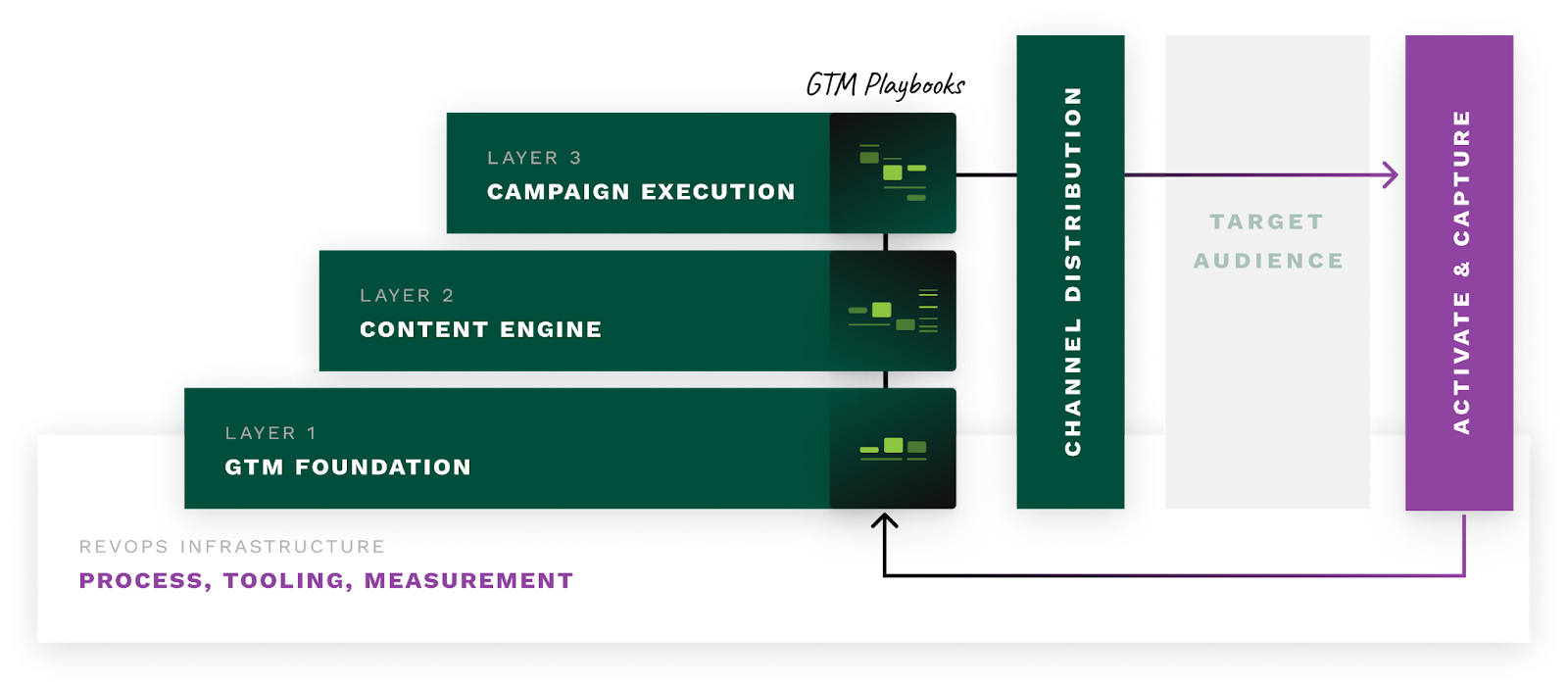
- GTM Foundation is the base. This is your positioning, messaging, and ideal customer profile. Does the company know who they actually sell to, and can they articulate why customers should buy from them. Messaging either stays consistent across the team or it doesn't. Positioning either gets written down or it lives in the founder's head.
- Content is what fuels awareness and demonstrates expertise. This is case studies, thought leadership pieces, nurture sequences, educational content. Content can be produced on a schedule or sporadically. It can align to the buyer journey or just be random top-of-funnel noise.
- Campaigns are how you put your strategy in motion. Campaigns can be structured around segments, buyer stages, or specific value props. Done well, campaigns have specific objectives, measurable outcomes, and keep your actions focused and intentional.
- Channels are where your audiences live, and serve as the pipelines that you activate to increase awareness and drive engagement. This is linkedIn, email marketing, reddit, paid ads, etc.
- Activate and Capture is how you convert the 5% of your audience that’s ready to act. This is a lead capture form on your landing page, lead magnets your audience bites on in direct social outreach, or your customer who replies to the monthly newsletter with a referral.
- RevOps Underneath. Are systems connected or siloed? Do you know your metrics or are you guessing? Do you have a CRM that actually tracks contacts, deals, and engagement across the stack, or are you managing spreadsheets masquerading as systems? RevOps isn't about having the fanciest tools. It's about having a platform that connects your foundation to your measurement, so you can see what's working and what isn't.
Growth is messy, non-linear, and multidisciplinary. Frameworks and systems add clarity and structure that help control the chaos. At scale, companies have to have systems or they break. At early stage, the hope is that if you build the right system from the beginning, you avoid the death march of trying to retrofit it later.
Every company we speak with has a different level of maturity across the framework. The trick is knowing when the existing setup is a long-term liability or an immediate opportunity.
How Do You Actually Spot This in Diligence?
The real work of GTM diligence is asking the right questions about each layer and knowing when you're looking at real answers versus vague reassurance. Spreadsheets are easy to write down. Knowing when to call BS on what you're being told is the hard part.
Here are the five questions we use to structure the conversation:
- What channels are actually working for growth? Not "what channels do you want to use." What's generating deals right now, and how much pipeline is each channel creating?
- How do you create content today? Who's responsible? Is there a schedule? Do people actually use it to sell, or does it sit on a shelf? Does it align to your buyer's journey, or is it random top-of-funnel noise?
- Walk us through a recent marketing campaign. Who planned it? How did it get organized? What were you trying to achieve? What actually happened? You'll learn more about how a company actually operates from one campaign than from any document they send you.
- For your active pipeline, what are the different lead sources? Break it down. If it's 90 percent founder referrals and 10 percent everything else, you know what you're inheriting.
- What's the average deal cycle duration for pipeline in the last 12 months? Not a single deal. Look at the last 12 months. If it's chaotic, you're seeing founder-dependent selling. If it's predictable, you're seeing a system.
The key is listening to how they answer. Do they describe a process, or do they describe people? Do they reference metrics, or do they tell you what they think should happen?
Case Study: The Software Company We Walked Away From
Last year, our team spent two months evaluating a tech-enabled services company that had household name clients, a solid delivery team, and reasonably unique software that was under invested in recently. On paper, it looked solid. Mid-market B2B SaaS business, $20M ARR, good margins, established customer base. The investment thesis made sense.
So we dug into the growth engine.
GTM Foundation was weak. Positioning existed but wasn't consistent across the team. Their content engine was minimal. Campaigns weren't structured. Channels were a mystery.
More importantly, the company had one person capable of selling. Not one person doing most things. One person the business actually depended on. He was the founder. He closed deals, maintained relationships, knew how the business worked. And he wanted out.
He was tired. He'd been running on fumes for three years, ready to hand it off and move on, and we knew this going in. But what the company underestimated was the degree to which their lack of any growth engine handicapped the deal.
We evaluated what it would take to fix this post-close. Build a GTM foundation. Create content. Structure campaigns. Enable a sales team to replace what one person was doing.
We walked away.
Six months later, the business was acquired by a competitor. Founder checked out like he said he would. Customers started churning. The revenue that looked solid in the data room turned out to be fragile. Every month, the business eroded a little more. The acquirer is now managing decline instead of managing growth.
The issues we identified weren't unsolvable. They were all things we could have fixed with our operating engine. But the founder was unrealistic on valuation, and the deal numbers didn't support what it would cost to fix it. Not all deals work out.
What the acquirer didn't spend: two months of diligence with operators who knew what to look for.
What they're spending now: managing the fallout.
Putting It Together: What the GTM Layers Tell You
When you evaluate a target company, you'll find different combinations:
Strong across all layers. This company has a real growth engine. Post-close, you're scaling and optimizing, not building from scratch. Low risk. Lower post-close investment.
Weak foundation, strong execution. This one is tricky. The team executes well, but execution depends on people. Positioning and messaging aren't locked down. Red flag. When that person leaves, execution falls apart. Moderate risk. Plan for significant change management post-close.
Weak execution, strong foundation. You're buying a platform with solid messaging and positioning. Campaigns and channels aren't built out yet. But you have something to build on. Moderate risk. High post-close investment in building execution, but you're not starting from zero.
Weak across all layers. This is spreadsheet theater. Real growth doesn't exist. You're buying a founder and hoping his network scales. It won't. High risk. Either massive valuation adjustment or pass.
How We Approach GTM Diligence
Other firms skip GTM assessment in PE diligence. Not because it's unimportant. Usually because it's unclear how to evaluate it without being a marketing expert yourself. So it gets skipped, or it gets delegated to consultants who'll hand you a 50-page report that doesn't help you make a decision.
We approach it differently.
Trelliswork joins your deal team as GTM operators during diligence. We sit in management meetings with you and the target company. We help you understand what actually exists and what doesn't. We ask the specific questions that separate real growth from founder-dependent hustle. We help you build a roadmap for what needs to happen post-close if you move forward.
Here's what that engagement looks like:
Two management meetings. We join your team in the room with the target company's leadership. We sit alongside your deal team as an extension of your team, not as external consultants. We dig into their channels, campaigns, and metrics. We ask about process and tooling. We help you get a clear picture of what's actually built versus what's aspirational. You understand the gap between where they are and where they need to be.
A realistic post-deal roadmap. Then we work with you to build a specific GTM roadmap for this company, this market, these people. Not a generic template. A plan that's actually executable. What needs to happen in month one. What needs to happen in quarter one. What gets fixed versus what gets rebuilt. What you're inheriting versus what you're building.
You close the deal with clarity about what you're acquiring and what it actually costs to scale it.
The Cost of Missing This
You can discover this in diligence. You price accordingly. You go in with eyes open about what you're buying and what you'll need to invest post-close.
Or you miss it. You assume that because the company has grown, they have systems. You close the deal. You onboard the company into your portfolio. And somewhere around month three or month four, you realize the growth engine doesn't actually exist. Now you're managing a broken revenue machine while you should be scaling it.
The valuation adjustment you didn't make in diligence becomes the operational headache you own in year one.
Evaluate the layers. Ask the hard questions. Decide what you're actually buying.
That's how you spot the difference between real growth and a spreadsheet.
Ready to derisk your next deal?
Value creators and deal teams use Trelliswork to pressure-test growth engines before the close. We embed with your team during diligence, identify the gaps that don't show up in a data room, and build realistic post-close roadmaps so you know exactly what you're buying and what it costs to fix.
See how we work with investors or get in touch to talk about your next deal.