


AUTHOR

Mike Nash

Articles and GTM thought leadership.

Search icon
categories
Thank you! Your submission has been received!
Oops! Something went wrong while submitting the form.
Articles

February 23, 2026

How to evaluate a GTM growth engine during PE diligence and spot the difference between real growth and spreadsheet theater.

PE GTM Series 1/4

Your investment team spent three months evaluating a $20M software company. The financials looked solid. The market was there. The product worked. Everything checked out until you sat down with their sales and marketing leader and asked a simple question: "Show me how you actually acquire customers."

What they showed you was a spreadsheet. Not a system. Not a process. Just a sheet with projected pipeline numbers that looked like they came from thin air. When you dug deeper, you found what was actually driving deals: the founder. His network. His ability to get on the phone and close. The company had a scattered marketing motion, no recent thought leadership building brand, and no repeatable customer acquisition process.

You killed the deal.

This isn't an edge case. Most companies in growth mode operate this way. They start with founder-led sales, and fewer companies actually evolve beyond this stage. They grow through founder hustle, not systems. And when you're evaluating acquisition targets or trying to understand the quality of a portfolio company's growth engine, you need a framework to spot the difference between real growth and spreadsheet theater.

The good news: you can evaluate this in diligence. The better news: you can use the same framework to assess and improve any company you acquire.

What a Modern Growth Engine Looks Like

A real growth engine has layers. Each layer is a system that works independently but connects to everything else. When all layers are operating, growth is predictable, repeatable, and doesn't depend on one person's rolodex.

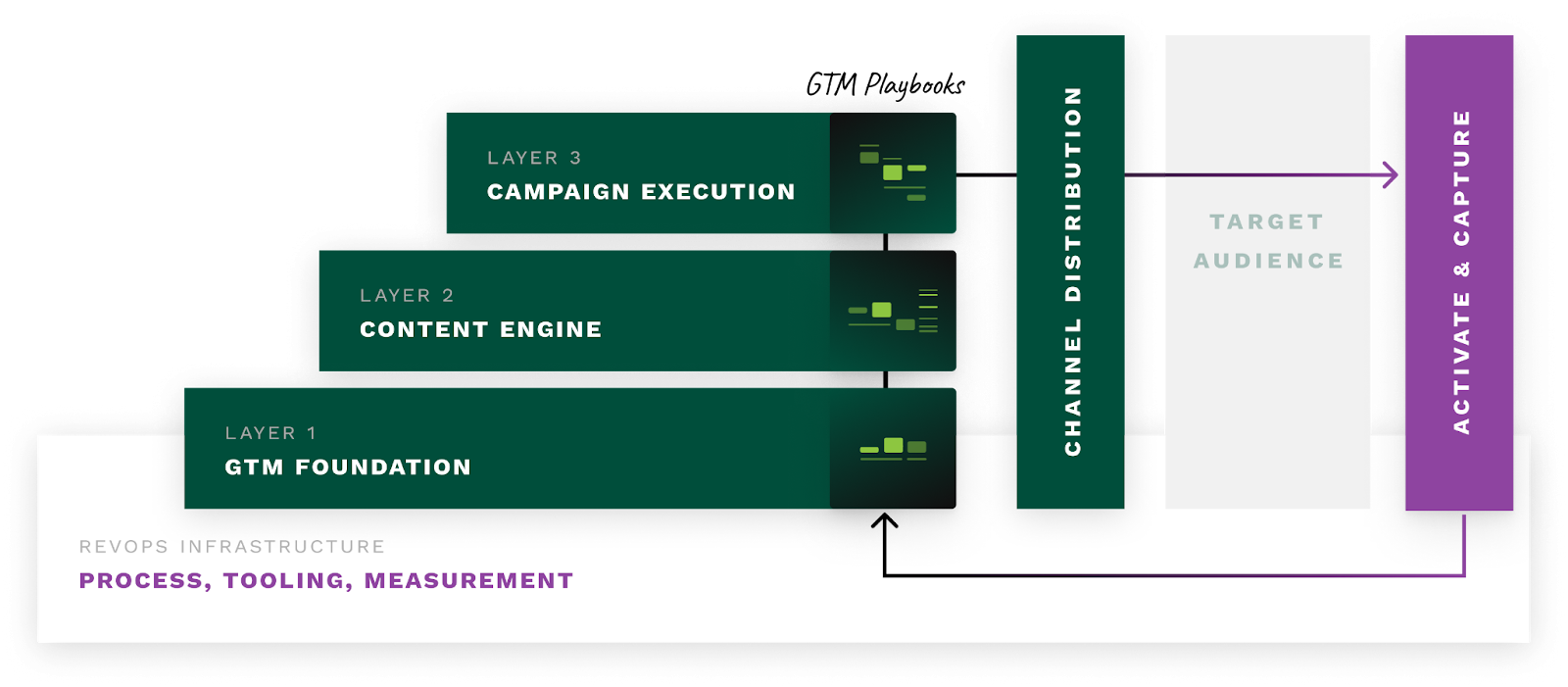
Here's the simplified system to show how we connect all the pieces:

  • GTM Foundation is the base. This is your positioning, messaging, and ideal customer profile. Does the company know who they actually sell to, and can they articulate why customers should buy from them. Messaging either stays consistent across the team or it doesn't. Positioning either gets written down or it lives in the founder's head.
  • Content is what fuels awareness and demonstrates expertise. This is case studies, thought leadership pieces, nurture sequences, educational content. Content can be produced on a schedule or sporadically. It can align to the buyer journey or just be random top-of-funnel noise.
  • Campaigns are how you put your strategy in motion. Campaigns can be structured around segments, buyer stages, or specific value props. Done well, campaigns have specific objectives, measurable outcomes, and keep your actions focused and intentional.
  • Channels are where your audiences live, and serve as the pipelines that you activate to increase awareness and drive engagement. This is linkedIn, email marketing, reddit, paid ads, etc.
  • Activate and Capture is how you convert the 5% of your audience that’s ready to act. This is a lead capture form on your landing page, lead magnets your audience bites on in direct social outreach, or your customer who replies to the monthly newsletter with a referral. 
  • RevOps Underneath. Are systems connected or siloed? Do you know your metrics or are you guessing? Do you have a CRM that actually tracks contacts, deals, and engagement across the stack, or are you managing spreadsheets masquerading as systems? RevOps isn't about having the fanciest tools. It's about having a platform that connects your foundation to your measurement, so you can see what's working and what isn't.

Growth is messy, non-linear, and multidisciplinary. Frameworks and systems add clarity and structure that help control the chaos. At scale, companies have to have systems or they break. At early stage, the hope is that if you build the right system from the beginning, you avoid the death march of trying to retrofit it later.

Every company we speak with has a different level of maturity across the framework. The trick is knowing when the existing setup is a long-term liability or an immediate opportunity.

How Do You Actually Spot This in Diligence?

The real work of GTM diligence is asking the right questions about each layer and knowing when you're looking at real answers versus vague reassurance. Spreadsheets are easy to write down. Knowing when to call BS on what you're being told is the hard part.

Here are the five questions we use to structure the conversation:

  1. What channels are actually working for growth? Not "what channels do you want to use." What's generating deals right now, and how much pipeline is each channel creating? 
  2. How do you create content today? Who's responsible? Is there a schedule? Do people actually use it to sell, or does it sit on a shelf? Does it align to your buyer's journey, or is it random top-of-funnel noise?
  3. Walk us through a recent marketing campaign. Who planned it? How did it get organized? What were you trying to achieve? What actually happened? You'll learn more about how a company actually operates from one campaign than from any document they send you.
  4. For your active pipeline, what are the different lead sources? Break it down. If it's 90 percent founder referrals and 10 percent everything else, you know what you're inheriting.
  5. What's the average deal cycle duration for pipeline in the last 12 months? Not a single deal. Look at the last 12 months. If it's chaotic, you're seeing founder-dependent selling. If it's predictable, you're seeing a system.

The key is listening to how they answer. Do they describe a process, or do they describe people? Do they reference metrics, or do they tell you what they think should happen?

Case Study: The Software Company We Walked Away From

Last year, our team spent two months evaluating a tech-enabled services company that had household name clients, a solid delivery team, and reasonably unique software that was under invested in recently. On paper, it looked solid. Mid-market B2B SaaS business, $20M ARR, good margins, established customer base. The investment thesis made sense.

So we dug into the growth engine.

GTM Foundation was weak. Positioning existed but wasn't consistent across the team. Their content engine was minimal. Campaigns weren't structured. Channels were a mystery. 

More importantly, the company had one person capable of selling. Not one person doing most things. One person the business actually depended on. He was the founder. He closed deals, maintained relationships, knew how the business worked. And he wanted out.

He was tired. He'd been running on fumes for three years, ready to hand it off and move on, and we knew this going in. But what the company underestimated was the degree to which their lack of any growth engine handicapped the deal.

We evaluated what it would take to fix this post-close. Build a GTM foundation. Create content. Structure campaigns. Enable a sales team to replace what one person was doing. 

So we walked away.

Six months later, the business was acquired by a competitor. Founder checked out like he said he would. Customers started churning. The revenue that looked solid in the data room turned out to be fragile. Every month, the business eroded a little more. The acquirer is now managing decline instead of managing growth.

The issues we identified weren't unsolvable. They were all things we could have fixed with our operating engine. But the founder was unrealistic on valuation, and the deal numbers didn't support what it would cost to fix it. Not all deals work out.

What the acquirer didn't spend: two months of diligence with operators who knew what to look for.

What they're spending now: managing the fallout.

Don't lose the farm.

Putting It Together: What the GTM Layers Tell You

When you evaluate a target company, you'll find different combinations:

Strong across all layers. This company has a real growth engine. Post-close, you're scaling and optimizing, not building from scratch. Low risk. Lower post-close investment.

Weak foundation, strong execution. This one is tricky. The team executes well, but execution depends on people. Positioning and messaging aren't locked down. Red flag. When that person leaves, execution falls apart. Moderate risk. Plan for significant change management post-close.

Weak execution, strong foundation. You're buying a platform with solid messaging and positioning. Campaigns and channels aren't built out yet. But you have something to build on. Moderate risk. High post-close investment in building execution, but you're not starting from zero.

Weak across all layers. This is spreadsheet theater. Real growth doesn't exist. You're buying a founder and hoping his network scales. It won't. High risk. Either massive valuation adjustment or pass.

How We Approach GTM Diligence

Other firms skip GTM assessment in PE diligence. Not because it's unimportant. Usually because it's unclear how to evaluate it without being a marketing expert yourself. So it gets skipped, or it gets delegated to consultants who'll hand you a 50-page report that doesn't help you make a decision.

We approach it differently.

Trelliswork joins your deal team as GTM operators during diligence. We sit in management meetings with you and the target company. We help you understand what actually exists and what doesn't. We ask the specific questions that separate real growth from founder-dependent hustle. We help you build a roadmap for what needs to happen post-close if you move forward.

Here's what that engagement looks like:

Two management meetings. We join your team in the room with the target company's leadership. We sit alongside your deal team as an extension of your team, not as external consultants. We dig into their channels, campaigns, and metrics. We ask about process and tooling. We help you get a clear picture of what's actually built versus what's aspirational. You understand the gap between where they are and where they need to be.

A realistic post-deal roadmap. Then we work with you to build a specific GTM roadmap for this company, this market, these people. Not a generic template. A plan that's actually executable. What needs to happen in month one. What needs to happen in quarter one. What gets fixed versus what gets rebuilt. What you're inheriting versus what you're building.

You close the deal with clarity about what you're acquiring and what it actually costs to scale it.

The Real Cost of Missing This

You can discover this in diligence. You price accordingly. You go in with eyes open about what you're buying and what you'll need to invest post-close.

Or you miss it. You assume that because the company has grown, they have systems. You close the deal. You onboard the company into your portfolio. And somewhere around month three or month four, you realize the growth engine doesn't actually exist. Now you're managing a broken revenue machine while you should be scaling it.

The valuation adjustment you didn't make in diligence becomes the operational headache you own in year one.

Evaluate the layers. Ask the hard questions. Decide what you're actually buying.

That's how you spot the difference between real growth and a spreadsheet.

Read More
Articles

January 22, 2026

The agencies pulling ahead right now aren't hiring. They're partnering. Here's how they are White-labeling the execution layer to specialized GTM partners.

A Different Kind of Restructuring

Every few months, another headline announces agency layoffs. The narrative focuses on AI displacement and budget cuts. But there's a different story playing out at mid-sized independent agencies.

These firms aren't shrinking. They're restructuring around a simple insight: the work clients pay premium rates for (strategy, relationships, business insight) is different from the work that eats up most of their headcount (content production, campaign execution, technical delivery).

So they're splitting the difference. Keep the strategic layer. White-label the execution layer to specialized GTM partners who do that work faster and cheaper.

Legal Services Got Here First

Law firms faced this inflection point before marketing did.

If you've used traditional outside counsel before you know what it feels like to get a $1,700 invoice for a 30 minute phone call and an updated legal doc. Everyone knew this industry was ripe for disruption, it just wasn’t possible until today's AI came along to handle the legal busywork.

Harvey AI went from zero to an $8 billion valuation by becoming the execution layer for law firms. Partners kept client relationships and strategic counsel. Harvey handled the document review, research, and drafting that used to employ armies of junior associates.

This same dynamic is in play now with GTM firms and marketing Teams.

The Economics Forcing This Conversation

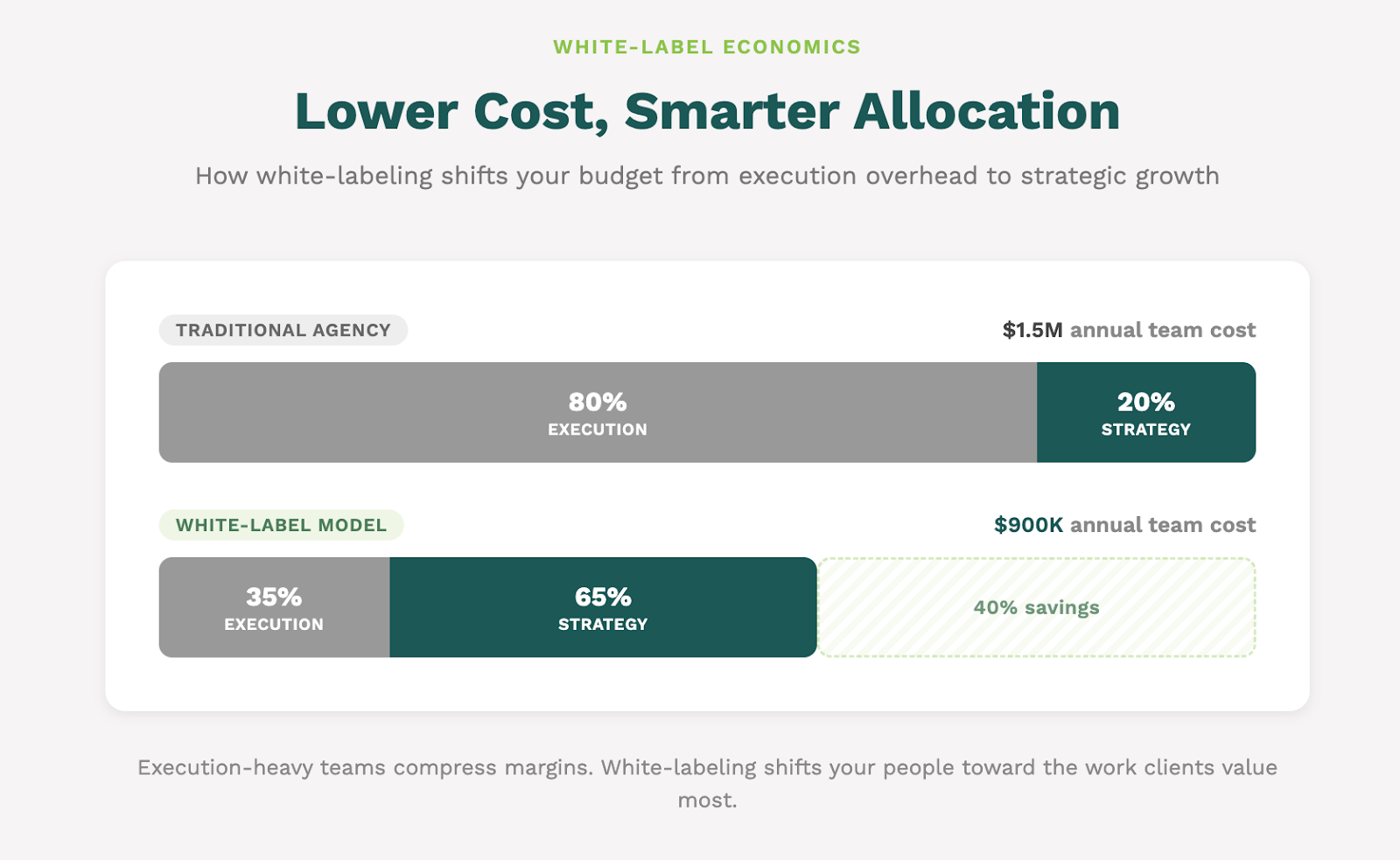
Mid-sized agencies typically run 60-70% of their headcount in execution roles: content writers, campaign managers, SEO specialists, designers, developers, analytics people. These roles are necessary, but they're where margins get compressed.

Execution work is increasingly commoditized. Clients benchmark your deliverables against competitors producing similar outputs with smaller teams and better tooling. Meanwhile, your execution staff expects annual raises, benefits costs climb, and turnover runs 20-30% annually.

You're running hard just to stay in place. The strategic work is where your differentiation lives, but execution overhead consumes capacity you could invest there.

Why Agencies Can't Build This Internally

Three reasons.

The talent market works against you. Engineers who understand AI-native workflows command $300,000+ packages. Even if you land someone good, they need infrastructure and time to build something useful. Most agencies underestimate the investment.

Your team can't retool fast enough. Your content team isn't becoming prompt engineers in a month. Training takes time you don't have, and clients won't subsidize your learning curve.

Your business model fights the change. Agencies built on billable hours struggle when AI compresses delivery timelines. If a project that took 40 hours now takes 15, do you bill for 15 and take the revenue hit? Its an option, but it doesn't represent the value you are creating.

How White-Label Partnerships Work

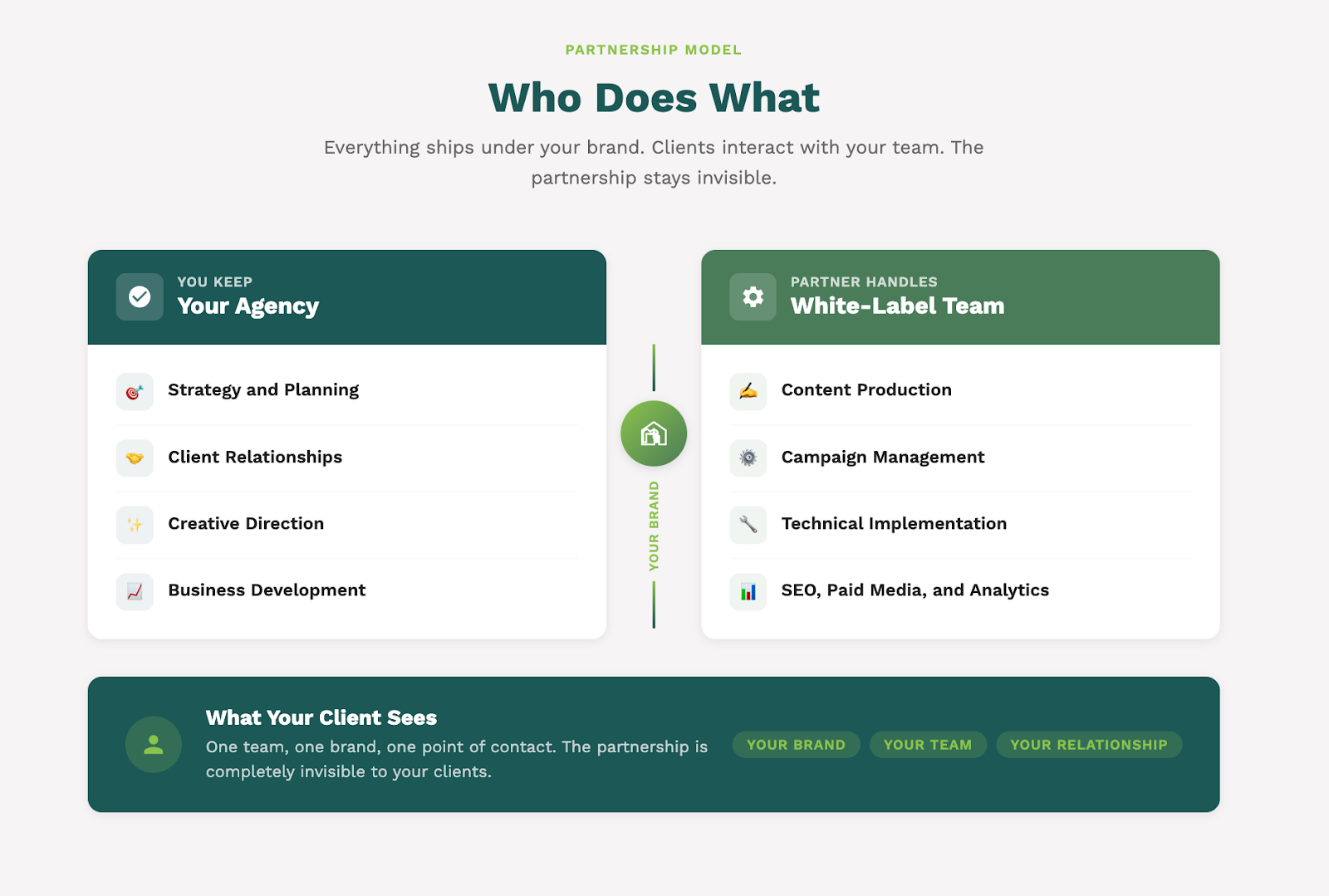
You keep: Strategy and planning, client relationships, creative direction, business development.

Your partner handles: Content production, campaign management, technical implementation, SEO and paid media, analytics infrastructure.

Everything ships under your brand. Clients interact with your team. The partnership stays invisible.

The Delivery Engine Behind It

A good GTM partner brings more than bodies. They bring a delivery engine: an existing framework, workflow, and system you plug into.

Consider what goes into publishing a single, high quality SEO article. You need a content calendar, keyword strategy to inform topics, and then a workflow for each piece: outline creation, gathering unique perspectives from the client, drafting, adding visuals, internal review, a featured image, client approval. Then internal links, optimization for the buyer journey stage, and finally publication. That’s a lot of moving parts for one article.

At Trelliswork, we use our 10/80/10 framework. The agency owns the first 10% (client relationship, strategic direction) and the last 10% (client review, final approval). We handle the 80% in the middle: all the execution and orchestration that turns strategy into deliverables. Content interactions get packaged up and shipped ready for the agency to present. The end client never sees Trelliswork. The agency maintains full ownership of the relationship while we run the engine underneath.

The Financial Impact

A $15 million agency with 22 employees might look like this:

Current state:

  • 8 people in strategy/client services: ~$960K loaded cost
  • 14 people in execution/production: ~$1.5M loaded cost
  • Operating margin: 12-15%

After restructuring:

  • Keep 8 strategy/client services people: ~$960K
  • White-label execution (typically 45-55% of internal cost): ~$750K
  • New operating margin: 18-23%

That's roughly $750K in annual savings. The flexibility matters as much as the savings: scale execution through your partner when you win big accounts, reduce scope without layoffs when accounts churn and simplify your bench management stress. Your cost structure becomes variable instead of fixed.

What Separates Good Partnerships From Bad Ones

Integration quality means your partner operates as an extension of your team. Shared project management, direct communication, aligned accountability. If you're spending hours coordinating handoffs, you've traded one overhead problem for another.

Strategic depth means your partner brings expertise that improves your work. They've seen patterns across dozens of clients and know what's working. They should elevate your strategy, not just fill orders.

The Competitive Window

Agencies restructuring now are building partner relationships and improving margins while competitors maintain the old model. That advantage compounds. Better margins fund better business development. Better business development wins more clients.

The agencies that wait will face the same economics eventually, but they'll be playing catch-up with less runway.

Making the Shift

First, map your current economics. What percentage of headcount sits in execution roles? What's your fully-loaded cost per deliverable type?

Second, identify the right partner. Look for GTM firms that handle the full execution stack under one relationship. Evaluate integration capabilities, not just deliverable quality.

Third, plan the transition. Start with a single service line or client segment, prove the model works, then expand scope gradually.

The agencies winning in 2026 are maintaining execution quality for clients while shifting their best people to think more strategically. To get there, it means retooling your delivery model. White-labeling is one option, but the shift is structural, not transactional.

Ready to explore what this could look like for your agency? The first step is understanding your current cost structure and where the leverage points are.


Frequently Asked Questions

What does it mean to white-label GTM for agencies?

A partnership where GTM firms handle execution (content, campaigns, SEO, paid media, analytics) under your agency’s brand. Clients never see the partnership. You keep strategy and client relationships.[1] 

How much can agencies save by white-labeling execution?

45-55% reduction in execution costs. For a $15M agency, that’s roughly $750K annually. Savings come from eliminating salaries, benefits, tools, and 20-30% turnover costs.

What functions should agencies keep in-house vs. white-label?

Keep in-house: strategy, client relationships, creative direction, business development. White-label: content production, campaign management, technical implementation, SEO/paid media, analytics.

How is agency white-labeling different from traditional outsourcing?

Traditional outsourcing sends discrete tasks to the lowest bidder. White-label partnerships integrate the partner into your team with shared systems, direct communication, and accountability. Good partners improve your strategy, not just execute orders.

Will clients know we're using a white-label partner?

No. All deliverables ship under your brand. Clients interact only with your team. The partnership stays invisible.

What should agencies look for in a white-label GTM partner?

Integration quality (shared project management, direct communication, aligned accountability) and strategic depth (cross-industry expertise that improves your work). Avoid partners requiring heavy coordination or lacking full GTM stack experience.

Read More
Articles

January 12, 2026

Learn how Model Context Protocol servers let you create deals, update pipelines, and manage HubSpot through natural language instead of endless clicking.

Model Context Protocol (MCP) servers let you manage your CRM through natural language instead of endless clicking. You'll learn what MCP servers do, how to create deals and run reports without opening HubSpot, and what limitations to expect while the technology matures.

Adding a deal to HubSpot takes about 17 clicks and two and a half minutes. You navigate to the right pipeline, tab through edit fields, fat-finger something, delete it, try again. By the time you're done, you've lost momentum on whatever you were actually doing.

Now imagine speaking a 7 second update and having the deal created automatically. The pipeline is correct. The close date is set. The contact is associated. You never opened HubSpot.

This is an example of what Model Context Protocol servers make possible. They create a conversational layer between you and your business systems, letting you interact with tools like HubSpot through natural language instead of clicking through interfaces.

Behind the Scenes

Think of MCP servers as translators. When you ask a question or give a command in plain English, the MCP layer converts that into the correct API calls for whatever system you're connecting to. The responses come back in readable form rather than raw data.

With a standard API integration, you need to know the exact endpoint, the correct formatting, the required fields. You're writing code or at minimum configuring something technical. With MCP, you describe what you want in conversational language and the protocol handles the translation.

The Model Context Protocol documentation provides a solid technical foundation if you want to understand the underlying architecture. The short version: MCP creates a standardized way for AI applications to connect with external data sources and tools. Instead of each integration requiring custom code, platforms can publish MCP servers that any compatible AI interface can use.

HubSpot recently released a bi-directional MCP server. This means you can both read data from HubSpot and write data back to it. You can ask questions like "show me all deals closing this month" and also give commands like "create a new deal with these details."

Important note: Write access through HubSpot's MCP server is currently in beta. Your company or partner admin needs to opt in before you can create or update records through the connection. Read access works immediately once you connect.

The Headless CRM Experience

The term "headless" comes from software architecture, where you separate the interface from the underlying functionality. A headless CRM means you get the data management and pipeline tracking without being forced into the CRM's interface.

For teams that spend their days in tools like Claude, Slack, or Notion, this is a welcome shift. Instead of context switching into HubSpot to update a deal, you update it from wherever you already are. The CRM becomes infrastructure rather than a destination.

Here's an actual prompt that creates a complete deal record:

"Add a new deal to HubSpot called 'NewCo GTM Assessment', assign it to me, associate the deal with Robert Duncan, set this to first deal stage in our pipeline, close date Mar 31, and set the lead source to 'Client Referral', deal type new business"

That single request handles what would otherwise require opening HubSpot, navigating to the pipeline, clicking "Add Deal," filling in the deal name, setting the amount, selecting the pipeline stage from a dropdown, picking a close date from the calendar widget, searching for and associating the contact, setting the deal type, configuring the lead source property, and finally clicking save.

The MCP server processes this, creates the deal record, makes all the associations, sets every field, and confirms what it did. Total time: seconds instead of minutes.

What This Looks Like in Practice

Setting up the HubSpot MCP connection in Claude requires enabling the connector in your settings. Once connected, you'll authorize specific tool functions the first time you use them. After that initial setup, the connection persists.

The real value shows up in recurring work. Updating deal stages, adding notes, changing amounts, associating new contacts. Each of these tasks involves multiple clicks and screen navigation in the traditional interface. Through MCP, they become single requests.

Task Traditional HubSpot Via MCP Server
Create new deal with all fields 17 clicks, ~2.5 minutes One prompt, ~10 seconds
Update deal stage 4-6 clicks One prompt
Add deal note 5-7 clicks One prompt
Associate contact with deal 6-8 clicks One prompt

The time savings compound quickly. If you're managing a pipeline with 20 active deals and touching each one even once per week, you're looking at hours reclaimed monthly.

Notice in the example prompt that you can reference contacts by name ("Robert Duncan") rather than hunting for record IDs or email address. You can use relative terms like "first deal stage in our pipeline" instead of memorizing exact stage names. The MCP layer handles the translation to HubSpot's internal structure.

Ad-Hoc Reporting Without the Formatting Fights

Anyone who has built reports inside HubSpot knows the frustration. You want a specific view of your data, but the report builder has opinions about how that data should look.

  • Formatting limitations
  • Visualization restrictions
  • Widget layout resizing
  • Dashboard vs Report level filtering
  • And it goes on...

MCP changes this dynamic. Instead of conforming to what HubSpot's reporting interface allows, you describe what you want to see and get it back in whatever format makes sense.

"Show me all deals by stage with associated contacts and last activity date, sorted by days since last touch."

The response comes back as structured data you can use however you'd like. No clicking through configuration screens. No wrestling with chart types that don't fit your data.

The real unlock here is iteration speed.

In HubSpot's report builder, changing a filter or adding a column means navigating back through configuration screens. With MCP, you refine your query conversationally. "Actually, filter that to just deals over $50k" or "Add the deal owner column" becomes a quick follow-up rather than a multi-click detour.

The tradeoff is a lack of standardized reporting while you're in iteration mode. You want your data to build on itself over time, to tell a story with trends and patterns, not start from scratch every week. This is where the opportunity to rethink what you really want your data to tell you comes in.

We're finding a middle ground to be most effective. You have a base set of reports that run like clockwork week over week. They drive accountability and data checks. Then all the exploration off of that data moves to ad hoc MCP prompts, augmenting the data story for that particular week.

Here's a simple example prompt:

"What changes were made across all deals in our Trelliswork GTM 2025 sales pipeline last week? Provide a summary with links to the deals in hubspot for reference."

Here's the async busywork delegated to Claude:

Here's the result:

Ultimately this gets me to an action I need to take, and that's the point. I could have clicked around to different reports and views in Hubspot, only to repeat the same process next week. But in this case I was able to follow-up with a set of prompts in Claude to update close dates, change deal stages, and then move on in life. 30 minute CRM tangent avoided.

This matters especially for revenue operations teams who need to slice data in ways HubSpot's preconfigured reports don't support. Custom queries that would require API development or third-party tools become natural language requests.

MCP's Limitations

MCP servers are still maturing. You'll encounter quirks. Sometimes the connection needs re-authorization. Sometimes the AI layer needs gentle reminders that it does have access to the tools you've configured.

The technology requires the right setup. You need Claude's desktop app or similar interface that supports MCP connections. You need the specific MCP server for the tool you're connecting to. Not every platform has released one yet.

Write operations require beta access through your HubSpot admin. If you're testing this personally, you may be limited to read operations until your organization enables the beta features.

One thing to expect: the MCP tool connections reset periodically and require re-authentication. Part of this is because these integrations are actively evolving. Just be prepared to reconnect from time to time as the technology stabilizes.

There's also a learning curve in how you phrase requests. Being specific helps. The example prompt above works well because it includes everything in one request: deal name, amount, pipeline stage, close date, contact association, lead source, and deal type.

Why This Matters for GTM Operations

Nobody loves their CRM.

Yet CRMs exist because pipeline visibility matters, because forecasting requires data, because revenue operations need structure. But the interfaces are friction-heavy by design. They prioritize data capture over user experience.

MCP servers represent a shift toward meeting teams where they work. If your revenue team lives in Slack and Claude and Gmail, they can now interact with HubSpot from those environments. The CRM still does its job. You just don't have to live inside it anymore.

This connects to a broader pattern in go-to-market operations. The tools that win are the ones that reduce busywork rather than create it. Automation that actually automates, rather than just moving clicks from one interface to another.

For teams evaluating their tech stack, MCP compatibility is worth considering as a factor. The platforms investing in these connection protocols are signaling that they understand where workflow is heading.

Getting Started

If you want to experiment with MCP servers and HubSpot, the workflow is similar whether you're using Claude or ChatGPT:

  1. Install Claude's desktop application (or use ChatGPT's interface)
  2. Navigate to settings and enable the HubSpot connector
  3. Authorize the connection to your HubSpot instance
  4. Start with simple read queries to test the connection
  5. Contact your HubSpot admin about enabling beta write access

The initial setup takes about fifteen minutes. After that, you're operating in a fundamentally different mode. Less clicking, more doing.


Frequently Asked Questions

Q: Do I need to be technical to use MCP servers with HubSpot?

No. The entire point of MCP is removing the technical barrier. You interact through natural language prompts like "create a new deal called X and assign it to me." The protocol handles the translation to HubSpot's API structure. If you can describe what you want in a sentence, you can use MCP.

Q: What is a headless CRM?

A CRM you interact with through APIs or AI prompts instead of its native interface. You get the data management without living inside the software.

Q: Is MCP reliable for daily use?

It's maturing. Connections reset periodically and need re-authentication. Best for teams comfortable with occasional troubleshooting as the technology stabilizes.

Q: Can MCP create deals in HubSpot?

Yes, but write access is in beta. Your admin must enable it. Read access works immediately. Once enabled, you create deals with a single prompt.

Read More
Articles

November 21, 2025

Most B2B executives think PR is dead. Here's why targeted PR strategy matters more than ever to build authority through authenticity.

Most B2B executives have a terrible relationship with PR. You've been burned by expensive press releases that went nowhere. You've paid $5,000 to PR Newswire, then another $500 just to fix a typo. You've watched your marketing team chase vanity metrics while your pipeline stayed empty.

So when someone suggests investing in a PR strategy, your first instinct is to say no.

But you're rejecting something much narrower than what PR strategy actually means. You think you're declining press releases and media placements. What you're really turning down is a systematic approach to building credibility, controlling your narrative, and creating the context that makes selling easier.

The problem isn't PR strategy itself. The problem is that most people define it too narrowly, confusing the tactics (press releases, media kits, journalist outreach) with the actual strategic work of establishing authority and trust in your market.

What PR Actually Means Today

Public relations has changed dramatically from its print-media origins, but the core hasn't shifted at all. PR is about connecting with audiences that matter to you in ways that matter to them. That's it.

The channels keep changing. Print became television, which became internet, which became blogs, which became LinkedIn and podcasts. Every few years, someone declares everything is different now. But the fundamentals remain constant: identify who influences your target audience, then build relationships with those influencers.

The problem is that most PR firms haven't helped business leaders understand this distinction. They've let the impression persist that PR means drafting press releases and hoping someone reads them. That's not PR. That's lazy execution masquerading as strategy.

Selling a Hard Concept? Try PR

Back in the day, a quantum computing company was getting terrible press coverage. They couldn't figure out why every article painted them negatively.

The answer turned out to be 12 computer science professors.

These 12 academics were the go-to sources for every major tech reporter covering quantum computing. They didn't like the company's technical approach. So every time a journalist called for background or commentary, these professors undermined the company.

The PR solution wasn't more press releases or better media training. It was building relationships with those 12 professors so they understood the company's approach better. Once those relationships shifted, the media coverage flipped.

That's modern PR. It's targeted, relationship-driven, and focused on the specific people who influence your buyers.

PR strategy isn't a separate function. It's a set of tactics and channels within your larger go-to-market system.

You already have foundational GTM elements: your ideal customer profile, your market focus, your brand promise. PR strategy applies those same foundations to a different set of tactics. Instead of email sequences or paid ads, you're using media relationships, thought leadership, and third-party validation. But the strategic inputs are identical.

This matters because PR can't work in isolation. It relies on the same ICP definition that guides your sales targeting. It reinforces the same brand promise that your marketing team communicates. It reaches the same narrow audience, just through different distribution channels.

Think of PR as a campaign grouping within your GTM system. You might run a content campaign, a demand gen campaign, and a PR campaign, all aimed at the same 500 target accounts. Each uses different tactics. Each measures different leading indicators. But they all ladder up to the same business outcomes.

Good PR gets prospects to the top of your funnel. But it also supports them throughout their buying journey. When a prospect gets cold feet during your sales process, an article or case study that appears at the right moment moves them forward. When they're doing due diligence, external validation from credible sources reinforces that your company is legitimate.

This is why PR should never be measured in isolation. The question isn't "how many press mentions did we get?" The question is "did this move our target audience toward the action we want them to take?"

If you're a mid-market company selling to healthcare CIOs, your PR strategy might involve three different campaigns: one for all healthcare CIOs broadly, one for CIOs in specific geographic markets, and one for CIOs who listen to particular podcasts. Each campaign drives specific outcomes that connect to your pipeline.

The Credibility Hierarchy

Not all channels carry equal weight. A feature in a major industry publication carries more credibility than a post on your company blog. An interview with a tough questioner carries more weight than a conversation with your business partner where you get softball questions.

This matters because credibility is the currency of PR. The more risk involved in a channel, the more credibility it typically carries. Reporters are paid to be objective, to represent their readers, and to question what executives tell them. When you survive that scrutiny and your message comes through intact, people trust it.

The same principle applies to other channels. A detailed customer case study where the client speaks honestly about implementation challenges carries more weight than marketing copy about your solution. A LinkedIn post where you share what went wrong on a project (and what you learned) builds more authority than 50 posts about your company's latest features.

Good PR guides you through these riskier channels. It helps you earn credibility in ways that actually change how your audience perceives you.

When You Actually Need PR Strategy

In simple terms, you need PR strategy when your buyers won't take meetings based on your outbound alone.

If your ideal customers are executives who check industry publications before returning calls, you need PR. If they ask their network about vendors before booking demos, you need PR. If they're influenced by what analysts say or what their competitors are doing, you need PR.

Most mid-market B2B companies face this reality fast. Their buyers don't respond to ads. They don't fill out lead forms. They want proof you're credible before they'll invest time talking to you.

Good PR delivers that proof. It creates the external validation that makes your sales team's job easier. It answers the "who else uses you?" question before prospects even ask it.

Think about your next 10% of revenue growth. Who are those buyers? What convinced the last three deals to say yes? If third-party credibility played any role in closing those deals, you need a PR strategy that creates more of it.

What AI Changes (And What It Doesn't)

AI tools help with PR strategy in specific ways. They're excellent at surfacing patterns and historical context. If you want to understand how other companies successfully repositioned in their markets, AI can point you in the right direction fast.

But AI-generated content has a problem. Most of what you get on first pass is generic slop. The output is better than what was possible two years ago, but there's no easy button that gets you the results you want.

AI becomes useful when you train it on your specific voice and perspective. This takes work. You can't use generic prompts and expect good results. But if you invest in training an AI tool to understand how you think and communicate, it can help you scale your thought leadership more efficiently.

The catch is that you need a distinctive voice in the first place. You need to know what you uniquely have to offer. You need positions and perspectives that come from real experience, not from regurgitating what everyone else says.

AI can accelerate production. It can't create the authentic perspective that makes your PR strategy work.

The Voice Problem

Most B2B companies struggle to develop a distinctive voice because they're afraid of closing doors. If you take a position, you might alienate potential customers. If you share a contrarian view, someone might disagree.

But generic positioning means no one listens at all.

Authenticity is what matters most. In a market saturated with AI-generated content and corporate-approved messaging, being real is your competitive advantage. Your prospects can smell manufactured authority from a mile away. They trust voices that sound like actual human experience, not committee-approved talking points.

This is what you're actively trying to bring out in your content. Not controversy for its own sake. Not hot takes designed to generate clicks. Just your actual perspective, grounded in what you've seen and done, communicated in a way that sounds like a real person talking.

You don't need to be controversial or pick fights. You need to have a perspective grounded in your real experience. When Anderson Consulting (now Accenture) declared in the late 1990s that technology drives strategy, not the other way around, they took a position that contradicted conventional wisdom. McKinsey and Boston Consulting Group disagreed.

Anderson Consulting turned out to be right. That perspective, consistently communicated across media relations, advertising, and sales conversations, helped fuel their growth into what became a massive global firm.

Your voice should reflect what you actually believe based on what you've seen and done. It should connect to problems your ideal customers face. It should give you something to rally around internally and something that makes prospects pay attention.

If you're a services company that lives and dies by client work, it's tempting to say yes to everything. But trying to solve every problem for everyone means you have nothing distinctive to say. Find the problem you solve better than anyone else. Build your voice around that.

Making PR Strategy Work

Good PR should be project-based, measurable, and finite. You shouldn't feel like you need PR people working for you forever. Start with specific goals tied to specific outcomes.

Maybe you need to flip the perception of 20 key prospects who currently buy from a competitor. Maybe you need to establish credibility with a new industry vertical. Maybe you need to position your CEO as a thought leader on a particular topic that matters to your buyers.

Define the goal clearly. Understand who influences the audience you're trying to reach. Then build a strategy to reach and persuade those influencers. In some cases, that might mean traditional media relations. In other cases, it might mean having coffee with six people who shape how your industry thinks.

The strategy should integrate completely with your broader go-to-market approach. Your PR efforts should reinforce your marketing campaigns and sales conversations. Your marketing content should build on the credibility your PR creates. Everything should point in the same direction.

And you should be able to explain clearly how the investment connects to pipeline and revenue. If you can't draw that line, either the strategy is wrong or you're not measuring the right things.

Are You Asking the Right Question?

The question isn't whether you need a PR strategy. The question is whether you're willing to do the hard work of figuring out what you stand for, who you're trying to reach, and what you want them to do.

If you can answer those questions clearly, PR becomes a practical tool for reaching and influencing the people who matter most to your business. If you can't answer them, no amount of press releases or media training will help you.

Start there. Figure out your voice. Understand your audience. Define the action you want them to take. Then build a strategy that connects those dots.

That's PR. Everything else is just tactics.

FAQs

What is B2B PR strategy? 

B2B PR strategy identifies who influences your buyers and builds relationships with those influencers. It's not press releases. It's targeted credibility building that moves specific audiences toward specific actions.

How is PR different from marketing?

PR earns credibility through independent validation. Marketing promotes directly. Think of it this way: PR gets prospects to the top of your funnel through trusted third parties like industry analysts, media, or peer recommendations. Marketing guides them through to conversion. PR prepares the field. Marketing plants and harvests. Both need to work together, with your PR creating the external validation that makes your marketing messages believable.

When should a company invest in PR?

When your buyers trust peer recommendations and industry experts more than your marketing. If prospects research extensively before talking to sales, you need PR.

Why do most companies fail at PR?

They spray generic press releases hoping someone notices. They don't know who they're trying to reach or what action they want. They measure press mentions instead of pipeline impact. Good PR requires knowing exactly which 50 people influence your best prospects, then systematically building relationships with those 50 people. Most companies skip that targeting work and wonder why their PR investment goes nowhere.

What does a PR strategy cost?

Expect $3,000-$15,000 monthly for project-based work. Start with 3-6 months targeting specific outcomes. Avoid open-ended retainers.

Should we hire in-house or use a consultant?

Use a consultant. In-house PR only makes sense at scale. Consultants bring cross-industry experience and established relationships. Start project-based, then evaluate.

How long before PR shows results?

Quick wins happen in 30-60 days. Relationship-driven PR takes 3-6 months for measurable impact. Sustainable authority that consistently drives pipeline takes 6-12 months. You're building trust and credibility, not running ads. Expect momentum to build as influencers start associating your company with specific expertise, then recommending you unprompted.

Read More
News

October 30, 2025

Trelliswork and Crown Social partner to deliver integrated creative and GTM systems for mid-market B2B. World-class creative meets revenue operations.

You can't build a revenue engine on systems alone.

We learned this working with a dozen B2B companies over the past ten months. They had the GTM infrastructure. They understood their ICP. Their sales process worked. But they struggled to capture attention in a market that got 20x noisier overnight.

Systems create reliability. Creative captures attention. You need both.

That's why we partnered with Crown Social.

The Problem Traditional Agencies Can't Solve

Most marketing agencies operate in one of two modes. Either they're creative shops charging enterprise rates and delivering campaigns in a vacuum, or they're execution houses running plays without strategic depth.

Neither model works for mid-market B2B companies generating $10M to $50M in revenue.

These businesses face a specific challenge. They compete against enterprise brands with massive budgets while serving sophisticated buyers who ignore generic content. They need world-class creative to stand out and technical GTM systems to convert attention into revenue.

Traditional agencies can't deliver this combination.

Creative agencies lack the technical expertise to build revenue systems. GTM consultants rarely have access to world-class creative talent. Both charge enterprise rates that don't match mid-market budgets.

The gap creates a real problem. You either invest in creative that looks great but doesn't connect to pipeline, or you build systems that generate activity without capturing attention.

Bridging the Gap

Crown Social brings creative production, social media strategy, and paid media capabilities through their in-house and distributed talent network. Trelliswork brings GTM systems and revenue operations that turn attention into pipeline and revenue.

Together we deliver what mid-market businesses actually need: integrated creative and GTM infrastructure where creative drives distribution, distribution feeds pipeline, and pipeline converts to revenue.

Here's how it works in practice:

You decide to launch a thought leadership campaign. Crown Social develops the creative strategy and produces content that actually captures attention. That content plugs directly into the distribution systems Trelliswork builds as part of your GTM infrastructure. The systems activate channels, track engagement, feed qualified activity to sales, and measure revenue outcomes.

No vendor coordination. No integration headaches. No choosing between creative excellence and revenue systems.

Running a paid social campaign becomes a switch you turn on, not a new vendor relationship to manage.

Mid-Market's Moment

The economics matter here.

Both companies operate without the overhead that drives enterprise agency pricing. Crown Social unites centralized strategy with a global network of influential creatives. Trelliswork provides fractional GTM leadership instead of expensive full-time teams.

This structure lets us deliver modern full-service capabilities at mid-market pricing. You get world-class creative, media strategy, advertising, GTM systems, and revenue operations without paying for enterprise overhead.

Traditional Marketing Agency RevOps Consultants Trelliswork
Creative Production
Media Strategy & Paid Campaigns
GTM Systems & Infrastructure
Revenue Operations
Pipeline & Revenue Attribution
Mid-Market Pricing

The partnership targets founder-led companies in B2B technology, health tech, and robotics. These businesses understand their market but struggle with the same fundamental challenge: how to stand out without building an entire marketing department.

You don't want to manage multiple agencies. You want integrated capabilities that work together to drive revenue growth.

A New Choice for Sales & Marketing Leaders

If you run sales and own marketing, this changes your options.

You no longer need to choose between investing in creative or building systems. You get both, integrated from day one, at a price point that makes sense for mid-market businesses.

If you're a one-person marketing team looking for scale, you gain access to world-class creative talent and technical GTM capabilities without hiring a full team or managing multiple vendor relationships.

The work becomes: define your GTM strategy, develop creative that captures attention, activate distribution channels, and measure what drives revenue. All integrated. All aligned to business outcomes.

This is what modern B2B marketing looks like when you stop forcing companies to choose between creative excellence and revenue systems.

Want to learn more? Reach out directly. Let's talk about what integrated creative and GTM infrastructure could do for your business.

Read More