Strategy
The Agency Survival Guide: Why Smart Firms Are White-Labeling GTM in 2025


A Different Kind of Restructuring
Every few months, another headline announces agency layoffs. The narrative focuses on AI displacement and budget cuts. But there's a different story playing out at mid-sized independent agencies.
These firms aren't shrinking. They're restructuring around a simple insight: the work clients pay premium rates for (strategy, relationships, business insight) is different from the work that eats up most of their headcount (content production, campaign execution, technical delivery).
So they're splitting the difference. Keep the strategic layer. White-label the execution layer to specialized GTM partners who do that work faster and cheaper.
Legal Services Got Here First
Law firms faced this inflection point before marketing did.
If you've used traditional outside counsel before you know what it feels like to get a $1,700 invoice for a 30 minute phone call and an updated legal doc. Everyone knew this industry was ripe for disruption, it just wasn’t possible until today's AI came along to handle the legal busywork.
Harvey AI went from zero to an $8 billion valuation by becoming the execution layer for law firms. Partners kept client relationships and strategic counsel. Harvey handled the document review, research, and drafting that used to employ armies of junior associates.
This same dynamic is in play now with GTM firms and marketing Teams.
The Economics Forcing This Conversation
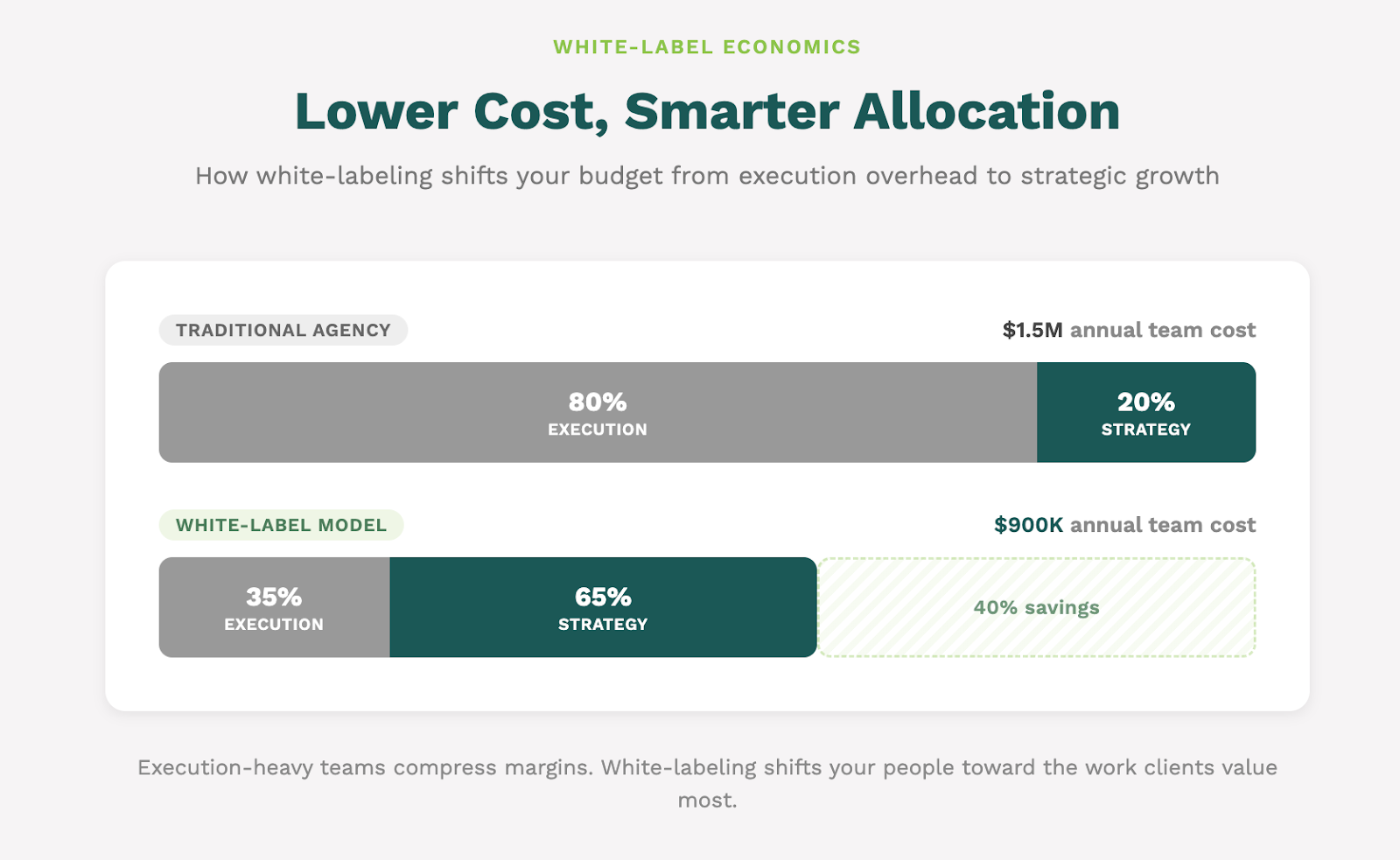
Mid-sized agencies typically run 60-70% of their headcount in execution roles: content writers, campaign managers, SEO specialists, designers, developers, analytics people. These roles are necessary, but they're where margins get compressed.
Execution work is increasingly commoditized. Clients benchmark your deliverables against competitors producing similar outputs with smaller teams and better tooling. Meanwhile, your execution staff expects annual raises, benefits costs climb, and turnover runs 20-30% annually.
You're running hard just to stay in place. The strategic work is where your differentiation lives, but execution overhead consumes capacity you could invest there.
Why Agencies Can't Build This Internally
Three reasons.
The talent market works against you. Engineers who understand AI-native workflows command $300,000+ packages. Even if you land someone good, they need infrastructure and time to build something useful. Most agencies underestimate the investment.
Your team can't retool fast enough. Your content team isn't becoming prompt engineers in a month. Training takes time you don't have, and clients won't subsidize your learning curve.
Your business model fights the change. Agencies built on billable hours struggle when AI compresses delivery timelines. If a project that took 40 hours now takes 15, do you bill for 15 and take the revenue hit? Its an option, but it doesn't represent the value you are creating.
How White-Label Partnerships Work
You keep: Strategy and planning, client relationships, creative direction, business development.
Your partner handles: Content production, campaign management, technical implementation, SEO and paid media, analytics infrastructure.
Everything ships under your brand. Clients interact with your team. The partnership stays invisible.

The Delivery Engine Behind It
A good GTM partner brings more than bodies. They bring a delivery engine: an existing framework, workflow, and system you plug into.
Consider what goes into publishing a single, high quality SEO article. You need a content calendar, keyword strategy to inform topics, and then a workflow for each piece: outline creation, gathering unique perspectives from the client, drafting, adding visuals, internal review, a featured image, client approval. Then internal links, optimization for the buyer journey stage, and finally publication. That’s a lot of moving parts for one article.
At Trelliswork, we use our 10/80/10 framework. The agency owns the first 10% (client relationship, strategic direction) and the last 10% (client review, final approval). We handle the 80% in the middle: all the execution and orchestration that turns strategy into deliverables. Content interactions get packaged up and shipped ready for the agency to present. The end client never sees Trelliswork. The agency maintains full ownership of the relationship while we run the engine underneath.
The Financial Impact
A $15 million agency with 22 employees might look like this:
Current state:
- 8 people in strategy/client services: ~$960K loaded cost
- 14 people in execution/production: ~$1.5M loaded cost
- Operating margin: 12-15%
After restructuring:
- Keep 8 strategy/client services people: ~$960K
- White-label execution (typically 45-55% of internal cost): ~$750K
- New operating margin: 18-23%
That's roughly $750K in annual savings. The flexibility matters as much as the savings: scale execution through your partner when you win big accounts, reduce scope without layoffs when accounts churn and simplify your bench management stress. Your cost structure becomes variable instead of fixed.
What Separates Good Partnerships From Bad Ones
Integration quality means your partner operates as an extension of your team. Shared project management, direct communication, aligned accountability. If you're spending hours coordinating handoffs, you've traded one overhead problem for another.
Strategic depth means your partner brings expertise that improves your work. They've seen patterns across dozens of clients and know what's working. They should elevate your strategy, not just fill orders.
The Competitive Window
Agencies restructuring now are building partner relationships and improving margins while competitors maintain the old model. That advantage compounds. Better margins fund better business development. Better business development wins more clients.
The agencies that wait will face the same economics eventually, but they'll be playing catch-up with less runway.
Making the Shift
First, map your current economics. What percentage of headcount sits in execution roles? What's your fully-loaded cost per deliverable type?
Second, identify the right partner. Look for GTM firms that handle the full execution stack under one relationship. Evaluate integration capabilities, not just deliverable quality.
Third, plan the transition. Start with a single service line or client segment, prove the model works, then expand scope gradually.
The agencies winning in 2026 are maintaining execution quality for clients while shifting their best people to think more strategically. To get there, it means retooling your delivery model. White-labeling is one option, but the shift is structural, not transactional.
Ready to explore what this could look like for your agency? The first step is understanding your current cost structure and where the leverage points are.
Frequently Asked Questions
What does it mean to white-label GTM for agencies?
A partnership where GTM firms handle execution (content, campaigns, SEO, paid media, analytics) under your agency’s brand. Clients never see the partnership. You keep strategy and client relationships.
How much can agencies save by white-labeling execution?
45-55% reduction in execution costs. For a $15M agency, that’s roughly $750K annually. Savings come from eliminating salaries, benefits, tools, and 20-30% turnover costs.
What functions should agencies keep in-house vs. white-label?
Keep in-house: strategy, client relationships, creative direction, business development. White-label: content production, campaign management, technical implementation, SEO/paid media, analytics.
How is agency white-labeling different from traditional outsourcing?
Traditional outsourcing sends discrete tasks to the lowest bidder. White-label partnerships integrate the partner into your team with shared systems, direct communication, and accountability. Good partners improve your strategy, not just execute orders.
Will clients know we're using a white-label partner?
No. All deliverables ship under your brand. Clients interact only with your team. The partnership stays invisible.
What should agencies look for in a white-label GTM partner?
Integration quality (shared project management, direct communication, aligned accountability) and strategic depth (cross-industry expertise that improves your work). Avoid partners requiring heavy coordination or lacking full GTM stack experience.