Strategy
We Tried to Buy a Business. We Built Trelliswork Instead.


Trelliswork wasn't the plan. Buying a business was.
Before we had a single client of our own, we spent months trying to buy a business we thought we could turn around. Roughly $25 million in revenue with Blue-chip enterprise clients. A book of business built over decades, a software asset that was dated but operational, and a list of operating problems that made it less attractive to larger buyers looking for a simple tuck-in. On paper, exactly the kind of company we were looking for.
We got all the way to diligence. Multiple rounds with the management team, deep on the financials, learning the day-to-day.
What we found became the reason Trelliswork exists.
The business we almost bought
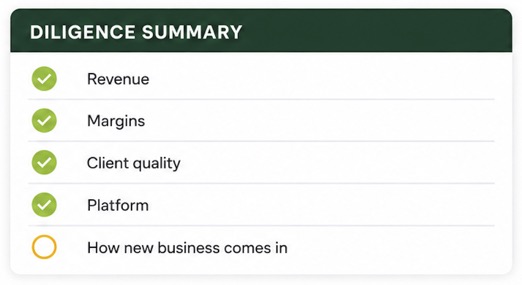
Good clients. Real margins. A platform that, while aging, still worked. Everything checked out, on paper.
Then we asked the one question that actually mattered. How does this business find and win customers?
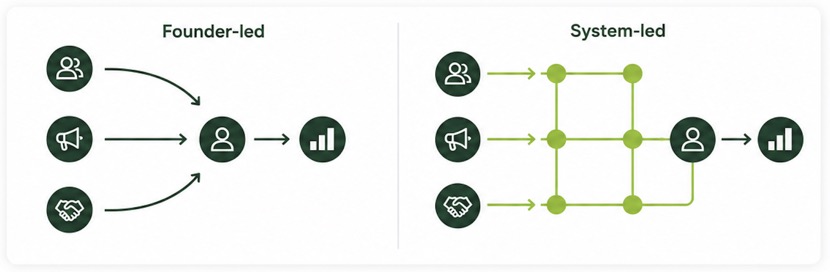
The founders. They had built the entire book on their own relationships, and after years of carrying it they were ready to walk away. Nothing sat behind them. No marketing function, no repeatable way new business found its way in the door. A few people, a spreadsheet, and no plan for what happened when they stepped back.
We didn't read that as a reason to pass, we read it as the plan.
Our plan was to fix exactly that
Our whole thesis for the deal was closing that one gap. We were going to install a modern GTM system and run it with focus and consistency, so new business no longer lived or died on a handful of relationships. Buy the company, build the engine, scale the model. That plan was the reason we wanted it.
The deal came apart over value. We couldn't line up with the seller on what the business was worth. That happens. The plan survived it.
The pattern was everywhere
Once we saw it clearly in that deal, we couldn't stop seeing it everywhere else.
Founder-led businesses, mid-market businesses, even smaller enterprises tend to look the same under the hood. Real expertise, loyal clients, real revenue, and a growth engine that begins and ends with a founder, or a trusted few. It isn't a flaw specific to distressed companies or bad operators. It's what happens when you build a business the way most people build one. You sell it yourself because you're good at it, and you never stop, because nothing else is in place to take over.
We've seen it from the other side of the table since, helping a private equity client evaluate an acquisition target of their own. We walked them away from that deal for the same reason.
That gap doesn't only cap how fast a business grows. It caps what the business is worth, and eventually, whether anyone will buy it at all. No acquirer wants to pay for a business that will crumble when the key rainmakers leave.
So we built the thing we couldn't buy
We didn't go find another acquisition target. We took the system we designed to turn that one business around and offered it as a service, to companies carrying more GTM work than their team can execute.
That system became Trelliswork built around what we call the 10/80/10 model. You own the first 10%, the strategy and the calls only you can make. We run the 80% in the middle, the production and the execution. You own the last 10%, review and approval.

Then we started delivering
The work taught us things we couldn't see from the outside.
We built Trelliswork for founder-led businesses first, the ones with all the right ideas and nobody behind them to execute. Running the model pulled us into the mid-market, and then further up, into companies with real budgets and real teams that still move slower than they should. The system doesn't get less useful as a company grows. It gets more useful.
Delivering the work also changed how we think a services firm should be built. That's its own piece, and we'll write it.
If your GTM has to move faster than your team can
That's the constraint we built for. Trelliswork is the GTM execution partner for B2B companies between $50 million and $500 million in revenue whose marketing has to move faster than the team allows. We bring the GTM system and get going in days, versus most large agencies that take three to four months to onboard.