Strategy
Your Context Is The Asset, Not Your Stack

A year of context work
Context is the word of the year in marketing and AI. Scott Brinker put it well in a recent piece: the work to capture context is much bigger than a few markdown files. Yep, learned this lesson.
We spent this year building and maintaining context for clients whose marketing teams run from zero to ten people. Our view of it changed a lot between January and October. We got some things right early and plenty wrong along the way.
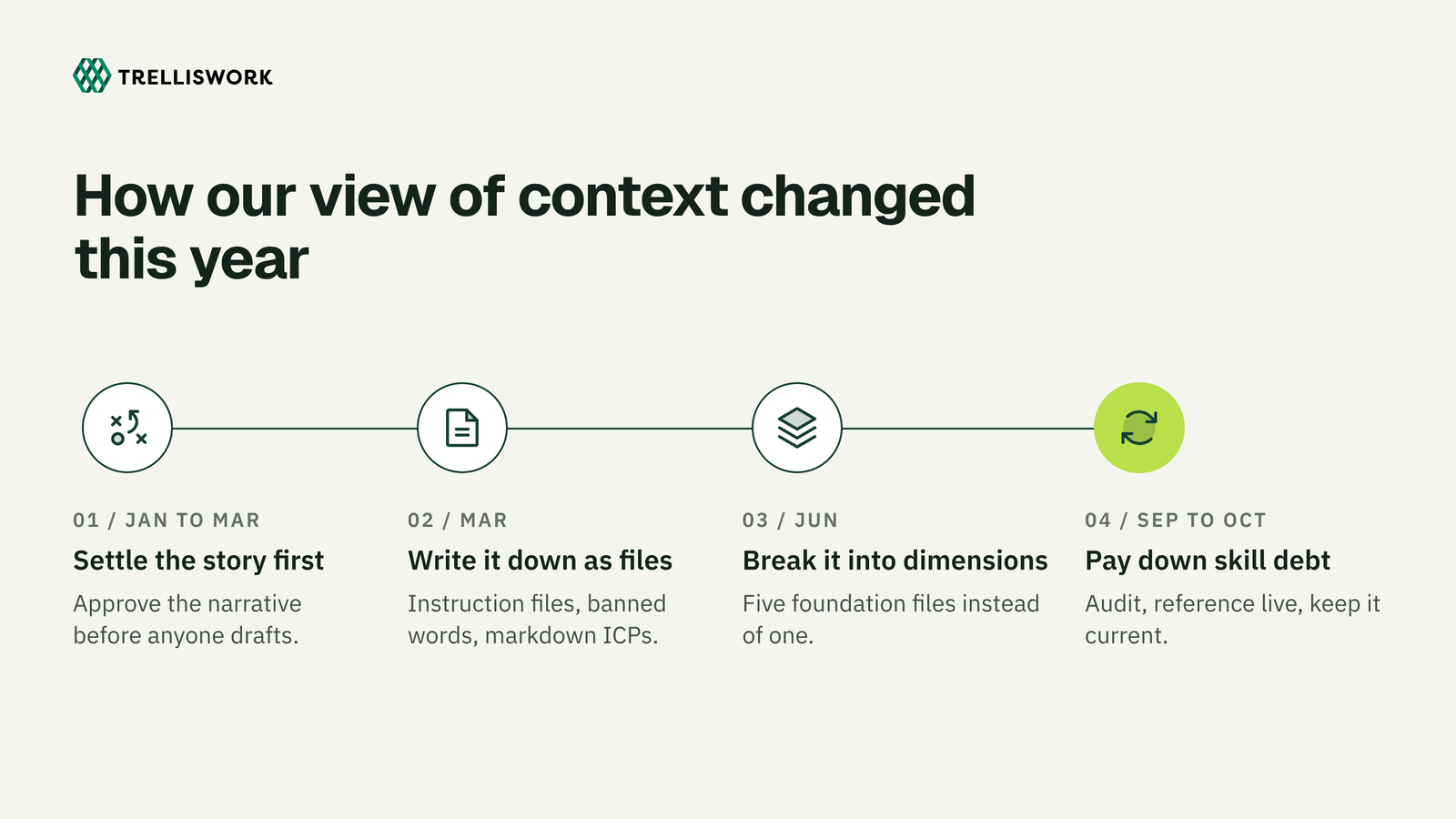
In January, one client's product story kept changing while we were drafting. The client reopened the narrative at every review, and we barely shipped anything. We fixed it with stage gates. The client approves the background first, then the narrative, then the content. We held the drafts until the story was stable.
In March, another client's AI offering depended on a partnership that wasn't signed yet. We held that content instead of writing around the gaps. When the details landed, we positioned the page around what they could actually deliver. Writing it early would have meant guessing, and AI guesses fluently.
That same month we started writing context down as standardized files with intentional structure. Each client folder got its own instruction file with brand rules and banned words. One client never uses the word "insurance," anywhere. We moved ICPs and brand guides out of PDFs and into plain markdown. A final review skill checked every piece before delivery.
Then we hit our first leak. A client leader was running work for two companies in one AI account, and the model pulled context from one company into drafts for the other. That is exactly what final human review is for. We separated the accounts and gave each client its own folder structure and instructions. Isolation cost us some convenience, and it meant running everything on a strict multi-tenant setup. It was worth it.
Midyear: what broke
By spring, some clients wanted their own specific, sometimes controversial views in their published content. So we stopped prompting and started capturing. Their executives record 15 minutes a week about real client problems, and we build the content from their words. We wrote about that shift in Stop Writing, Start Capturing.
In June, we went deeper. We had been treating context as a brand file or two per client. We started breaking it into separate dimensions instead. For one new client, we took in about 30 documents in the first three days and built five foundation files: ICP, competitive analysis, marketing positioning, brand positioning, and brand promise. Every content engine on that account draws from those five files.
One Saturday that June, Mike and I thought we had a brilliant idea. A context wallet: your company's context, packaged so you could carry it from tool to tool. A quick Google search killed that dream. Yep, they exist. Not so brilliant. Back to client work.
By September we had too much context instead of too little. We had built so many skills that they started working against us. We were still feeding client work from an ICP written the previous fall. One executive's voice skill picked up a sign-off from a single post and started adding it everywhere.
We started calling it skill debt. No one notices it piling up, but then output gets worse, and the team usually blames the latest model release (me).
What the year added up to
Speed caused most of these problems. AI drafts faster than any review process can keep on brand. The answer is to write company knowledge down in a form machines can use, push changes through when that knowledge updates, and decide where a person stays in the loop.
Most company context never makes it into any system. Our client foundations started as decks, call notes, and things people simply knew. Turning them into usable files was the bulk of the work.
For teams of zero to ten people, two things stand out.
Keep it portable, and make it the client's
Plenty of platforms now want to hold your context for you. For mid-market teams, the first question is where that context lives. When Claude went down earlier this year, we moved our client skills to two other models and were working again in about fifteen minutes. We covered that in Claude is Down. Now What? It worked because our skills are plain files on an open standard, stored in a repository we control.
The outage changed how we think about ownership. The context we build belongs to the client and they get access to the repository since it's their knowledge anyway.
Plan for upkeep
Building the files takes weeks and kleeping them current never stops. A client's context goes stale the day the client changes its pricing, its ICP, or its point of view. A mid-market company rarely has someone whose job is to catch that, but someone still has to own it.
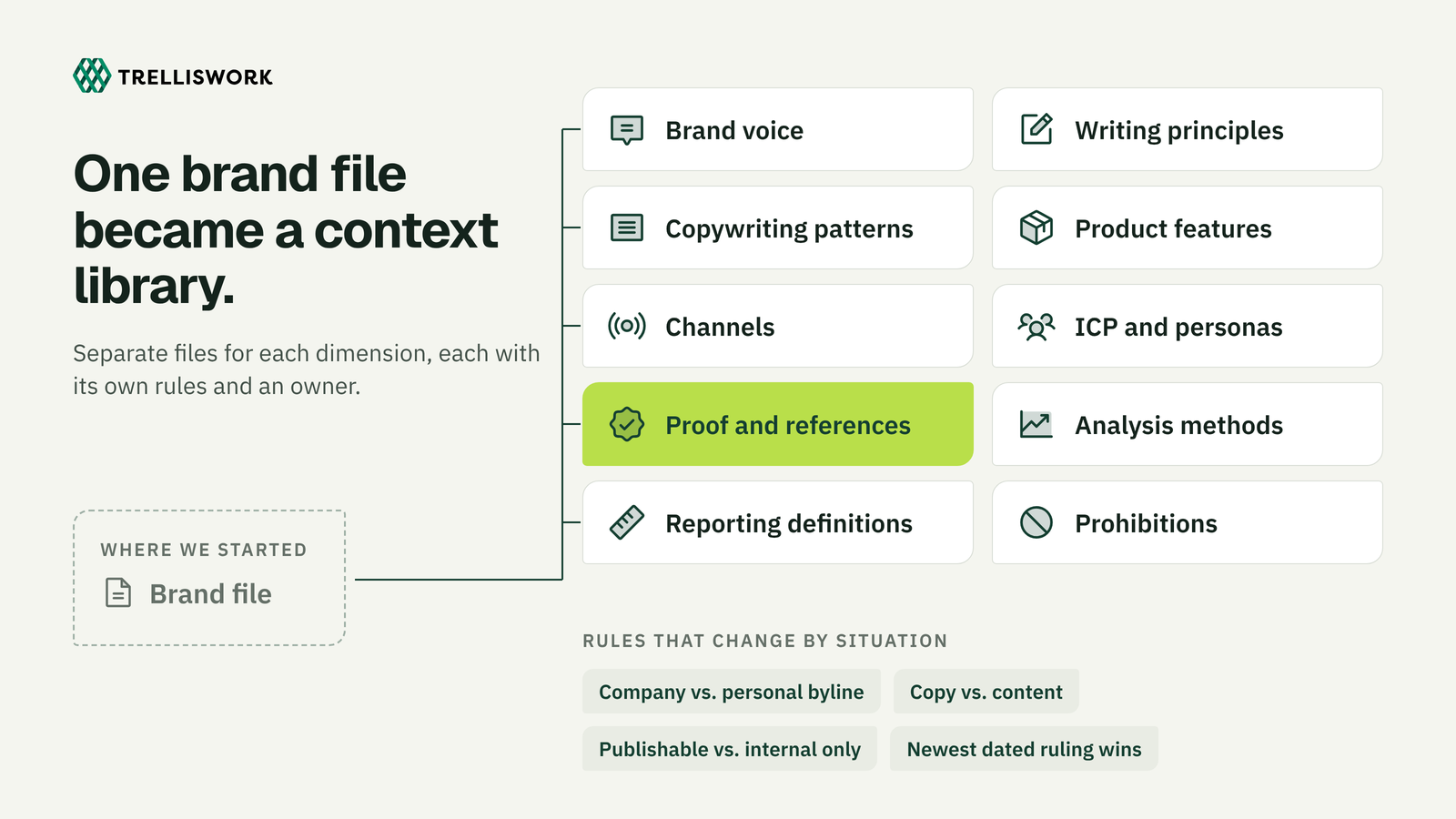
Some of our more advanced clients have built their own context libraries and expect their staff and partners to work from them. One ecommerce software client organizes its library like a codebase, with separate files for each dimension:
- Brand voice, shared writing principles, and copywriting patterns
- Product features, channel briefs, ICP, and personas
- Approved customer references, which customers must stay anonymous, and exactly how to quote each one
- Analysis methods and reporting definitions, so every metric means the same thing everywhere
- A prohibitions list of blocked claims and strings, plus things never to promise
Our job with that client is different. We don't write their context, we reference it live and make sure our work lines up with it. It sounds simple but in practice it broke twice. First, a file reference failed to load, and the wrong voice showed up in social drafts. Then a teammate had three of the client's four skills installed and was missing the brand file. The fix was a shared plugin that loads the client's files by default, plus a check in each workflow that confirms the right files loaded.
What we do now
We work from seven practices today.
- Settle the story first. Approve the background and narrative before anyone drafts. Don't write around gaps in the facts.
- Write it down as files, not decks. ICP, brand voice, messaging, verified claims, and expert positions each get a file. For one client, that's about six files in a shared repository. Their team connects to it directly, so one update reaches everyone at once.
- Write down what not to say. Banned words, claims you can't prove yet, and the ways your content usually goes wrong. Without these, a model writes generic copy.
- Capture, don't prompt. Real words from your experts beat any prompt written from scratch.
- Keep one source, and keep clients apart. Reference each skill instead of copying it. Give every client its own folder and instructions.
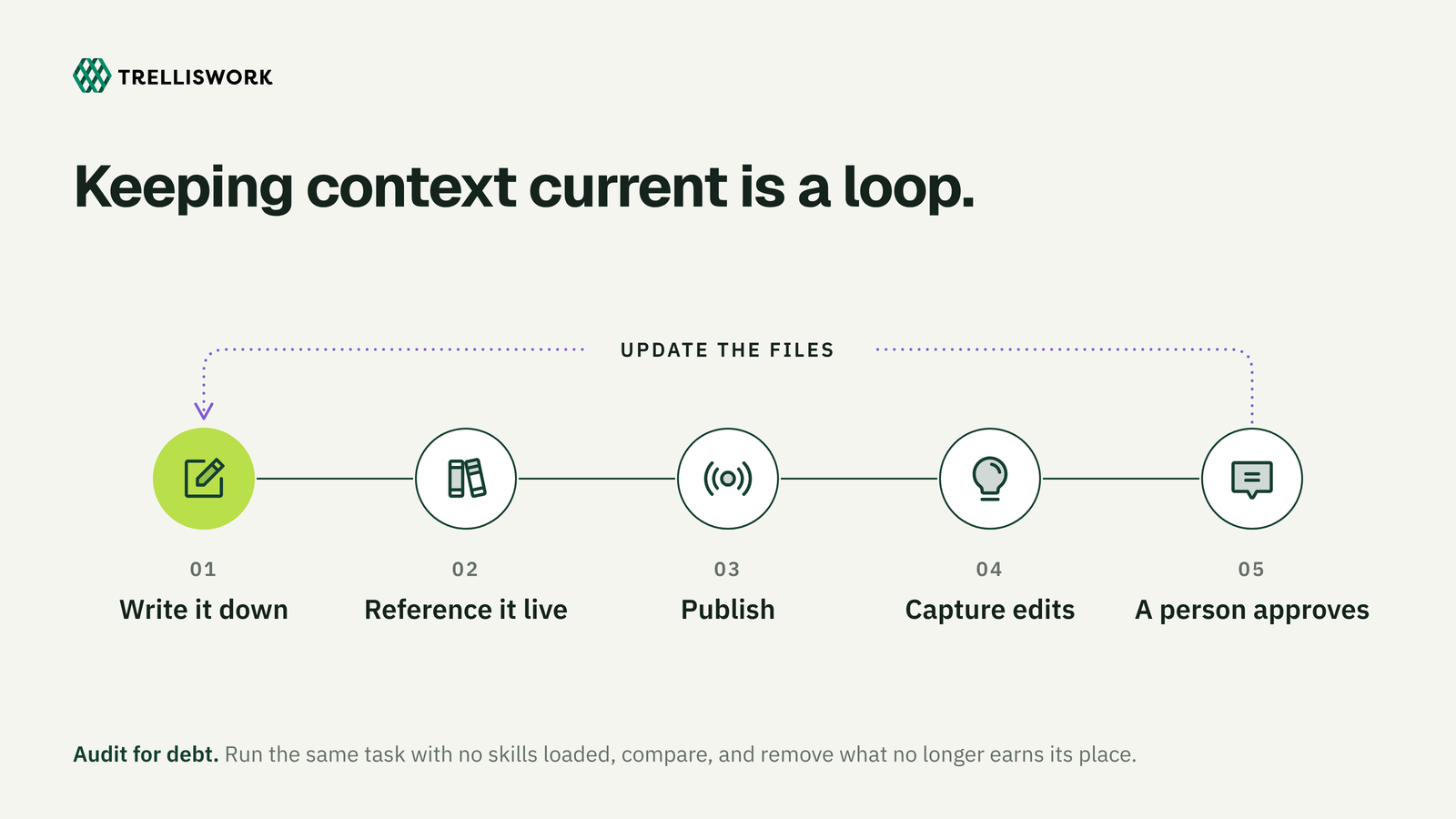
- Close the loop. After something publishes, capture the edits and ask whether they belong in the voice file. Log the AI tells that slip through and review them weekly. A person approves every change.
- Audit for debt. Run the same task with no skills loaded and compare. Remove whatever no longer earns its place.
The seven practices don't take long to start. Brand rules take about a week and expert positions take about a month. The history of what you rejected and why takes a year, and that's the part that compounds. We laid out that timeline in What an AI-Native Marketing Organization Is.
What comes next
This year was about getting context written down. Next year is about keeping it current and consistent across every tool and campaign.
Your tools will keep changing. The context they run on shouldn't have to. So ask three questions. Is your context written down? Is it current? Is it yours?
If the answer to any of them is no, that's where we start. We build the context with your team, run the system with you in the loop, and you keep the keys.
Book a working session, and we'll map what your AI tools know about your business today.