Strategy
Is It Time to Buy a CRM? Our Take for 2026


A client asked us a simple question this week. Was it finally time to bite the bullet and install a CRM? And had we given up on CRMs altogether, now that AI tools can rebuild what used to feel like complicated software in an afternoon?
Our answer had two parts. Yes, we've grown skeptical of the traditional CRM. And yes, they should still buy one. Just not the kind they were picturing.
Here's how we think about CRMs today, and what we'd tell any mid-market team facing the same decision.
The work changed before the CRM did
For twenty years, a CRM bundled two things. It stored your customer data, and it gave your team the only way to reach that data. You paid for both together because you had no other option. Building your own system meant a dev team and a six month project.
That trade no longer holds. You can describe a workflow in plain language today and have a working version by the end of the day. Data capture, lead routing, enrichment, a weekly pipeline report. Each of those used to justify a higher feature tier. Now each one is a small build.
So the question shifts. You're no longer asking which CRM has the most features. You're asking where your data should live so every person, tool, and AI agent on your team can reach it.
We saw this coming early. Before most of the market moved, we built a natural language interface on top of a CRM, because asking a question in plain English beat clicking through six reports. The market has caught up since then, and that's a good thing for every buyer.

The big platforms are heading the right way
HubSpot is investing in AI agents, AI reporting, and new ways to work with your data. That's the right direction, and we expect the product to keep getting better. If your team already runs well on HubSpot, with clean data and people who use it every day, staying put is often the smart call.
For a company buying its first CRM, the math looks different. The tier this client would need for the newer AI features runs about $1,800 a month. HubSpot is also moving to a credit model for AI usage, which makes monthly cost harder to predict while that model settles. And any large platform asks your team to change how they work. That behavior change is where most CRM rollouts stall.
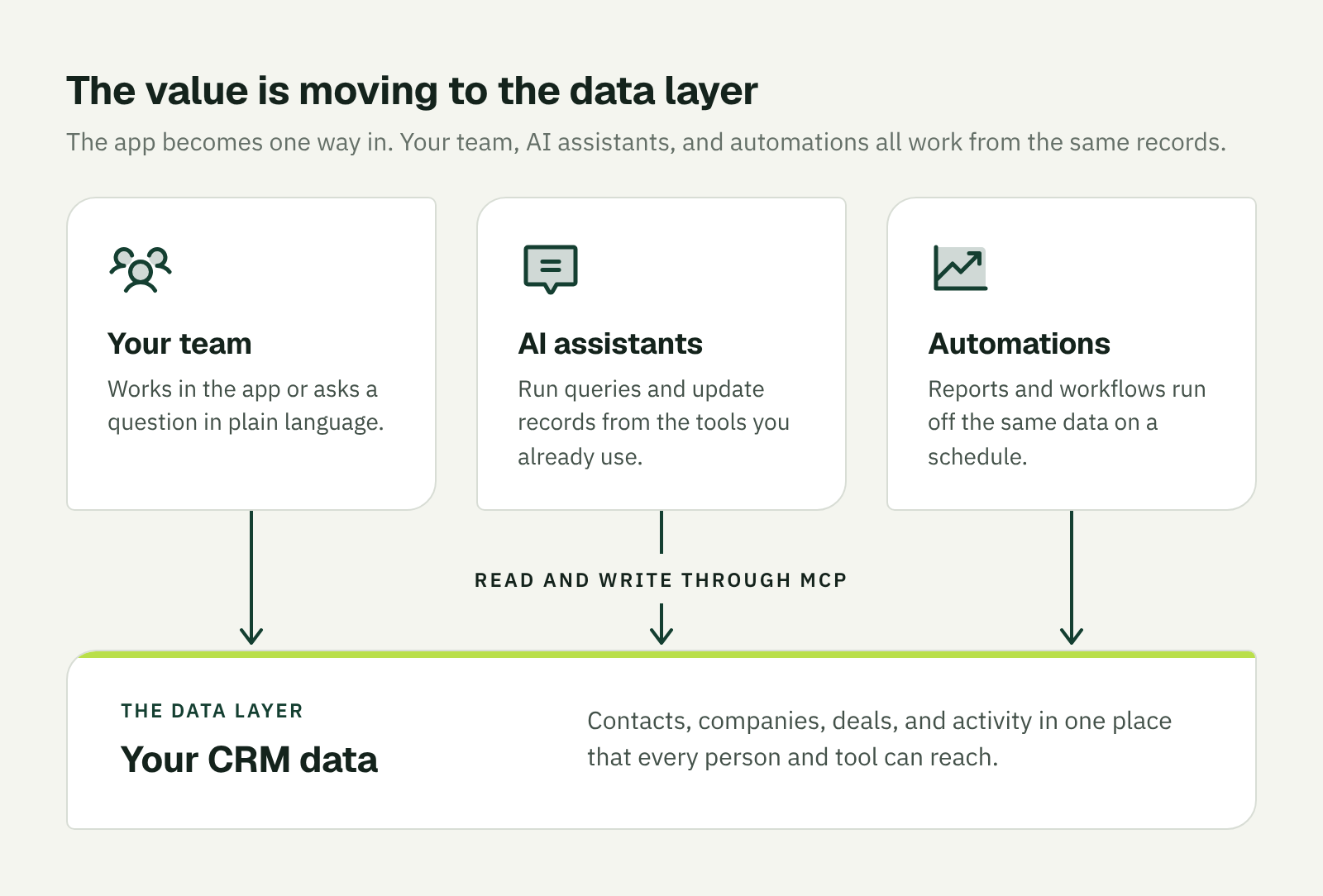
We've noticed something with our own HubSpot clients. We spend less time inside the HubSpot interface every month. We run reports, data queries, and record updates through MCP (Model Context Protocol), the standard that lets AI assistants read and write to business systems. HubSpot still holds the data and does that job well. The interface just matters less than it used to.
That's the shift. The value of a CRM is moving from the screens you log into toward the data layer underneath.
AI native CRMs start from the data
A newer group of CRMs starts from that data layer instead of adding AI on top of an older product. Attio is the one we're watching most closely. You shape the data model around your business, not the other way around. It's built for AI tools and agents to connect to from day one. And it asks far less of your team to get started.
We're early with Attio ourselves, and we'll share more as we go. One moment stuck with us. We moved Trelliswork's own CRM data into Attio in about 10 minutes with Claude.
That number changes how you should think about the decision. When a migration takes minutes instead of months, picking a CRM stops being a five year commitment. You can start small, prove it works, and move more over when you're ready. Lower switching cost means you buy for what you need now, not for every feature you might need someday.
We expect the whole category to head this way. Lighter tools, open access to your data, and AI doing the busywork your reps used to skip.
How we'd set it up
Most teams that ask us about a CRM aren't short on pipeline tools. They're short on one place where the small stuff comes together. A whitepaper download here, an email reply there, a list of event contacts sitting in someone's spreadsheet. Without a system, that context ends up scattered and never where you need it.
So we wouldn't start with the core pipeline. We'd start with a separate CRM for demand generation, covering outbound prospecting and inbound requests from the website. That keeps prospecting noise out of your core pipeline data, while keeping the two connected when you need them to be.
The flow runs like this:
- Someone raises their hand. They download a whitepaper, reply to an email, or follow up after an event.
- We triage the signal and decide whether it's real.
- Real signals go to your sales lead, with the context already attached.
- Your sales lead qualifies the conversation.
- Sales qualified opportunities become new deals in your core pipeline.
Automation carries most of the load. Take a trade show. With this setup in place, outreach to every attendee runs on autopilot, and the replies land in the right place without anyone copying names out of a spreadsheet.
Attio also ships with full pipeline management. You can move your core pipeline over whenever it makes sense, or keep it where it lives today.
Bite a new bullet
So, is it time to buy a CRM? For most mid-market teams still running on spreadsheets and inboxes, yes. Just buy for where CRMs are going, not where they've been.
Here's what we'd look for:
- Open access to your data. Your AI tools and agents should read and write to it without workarounds.
- A light start. Begin with demand generation, where the gaps cost you the most today, and expand from there.
- Low switching cost. If moving your data takes minutes, you're not locked into a bad choice.
- Your security and compliance bar. Check this first. A newer tool has to clear the same review as an established one.
If you already run well on HubSpot or another established platform, don't rip it out. Connect to it through MCP and let the data do more work for you.
For this client, the answer was simple. If Attio clears their security review, we'll build the demand generation engine around it with them. It supports the content program we're already running together, and it gives them a data layer they don't have today.
If you're weighing the same decision, let's map where your pipeline actually comes from.