

AUTHOR

Mike Nash

Articles and GTM thought leadership.

Search icon
categories
Thank you! Your submission has been received!
Oops! Something went wrong while submitting the form.
Articles

November 21, 2025

Most B2B executives think PR is dead. Here's why targeted PR strategy matters more than ever to build authority through authenticity.

Most B2B executives have a terrible relationship with PR. You've been burned by expensive press releases that went nowhere. You've paid $5,000 to PR Newswire, then another $500 just to fix a typo. You've watched your marketing team chase vanity metrics while your pipeline stayed empty.

So when someone suggests investing in a PR strategy, your first instinct is to say no.

But you're rejecting something much narrower than what PR strategy actually means. You think you're declining press releases and media placements. What you're really turning down is a systematic approach to building credibility, controlling your narrative, and creating the context that makes selling easier.

The problem isn't PR strategy itself. The problem is that most people define it too narrowly, confusing the tactics (press releases, media kits, journalist outreach) with the actual strategic work of establishing authority and trust in your market.

What PR Actually Means Today

Public relations has changed dramatically from its print-media origins, but the core hasn't shifted at all. PR is about connecting with audiences that matter to you in ways that matter to them. That's it.

The channels keep changing. Print became television, which became internet, which became blogs, which became LinkedIn and podcasts. Every few years, someone declares everything is different now. But the fundamentals remain constant: identify who influences your target audience, then build relationships with those influencers.

The problem is that most PR firms haven't helped business leaders understand this distinction. They've let the impression persist that PR means drafting press releases and hoping someone reads them. That's not PR. That's lazy execution masquerading as strategy.

Selling a Hard Concept? Try PR

Back in the day, a quantum computing company was getting terrible press coverage. They couldn't figure out why every article painted them negatively.

The answer turned out to be 12 computer science professors.

These 12 academics were the go-to sources for every major tech reporter covering quantum computing. They didn't like the company's technical approach. So every time a journalist called for background or commentary, these professors undermined the company.

The PR solution wasn't more press releases or better media training. It was building relationships with those 12 professors so they understood the company's approach better. Once those relationships shifted, the media coverage flipped.

That's modern PR. It's targeted, relationship-driven, and focused on the specific people who influence your buyers.

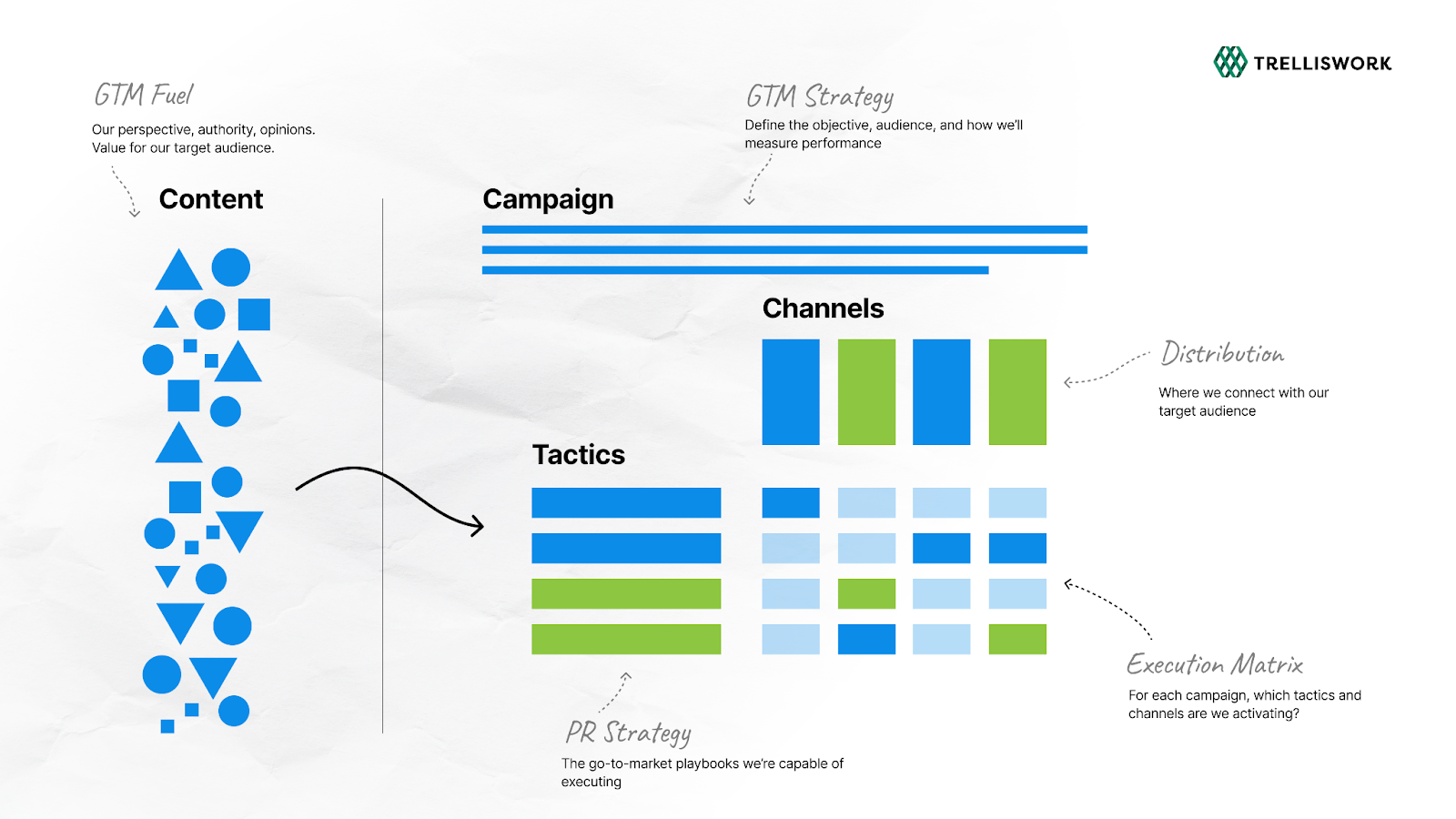
PR strategy isn't a separate function. It's a set of tactics and channels within your larger go-to-market system.

You already have foundational GTM elements: your ideal customer profile, your market focus, your brand promise. PR strategy applies those same foundations to a different set of tactics. Instead of email sequences or paid ads, you're using media relationships, thought leadership, and third-party validation. But the strategic inputs are identical.

This matters because PR can't work in isolation. It relies on the same ICP definition that guides your sales targeting. It reinforces the same brand promise that your marketing team communicates. It reaches the same narrow audience, just through different distribution channels.

Think of PR as a campaign grouping within your GTM system. You might run a content campaign, a demand gen campaign, and a PR campaign, all aimed at the same 500 target accounts. Each uses different tactics. Each measures different leading indicators. But they all ladder up to the same business outcomes.

Good PR gets prospects to the top of your funnel. But it also supports them throughout their buying journey. When a prospect gets cold feet during your sales process, an article or case study that appears at the right moment moves them forward. When they're doing due diligence, external validation from credible sources reinforces that your company is legitimate.

This is why PR should never be measured in isolation. The question isn't "how many press mentions did we get?" The question is "did this move our target audience toward the action we want them to take?"

If you're a mid-market company selling to healthcare CIOs, your PR strategy might involve three different campaigns: one for all healthcare CIOs broadly, one for CIOs in specific geographic markets, and one for CIOs who listen to particular podcasts. Each campaign drives specific outcomes that connect to your pipeline.

The Credibility Hierarchy

Not all channels carry equal weight. A feature in a major industry publication carries more credibility than a post on your company blog. An interview with a tough questioner carries more weight than a conversation with your business partner where you get softball questions.

This matters because credibility is the currency of PR. The more risk involved in a channel, the more credibility it typically carries. Reporters are paid to be objective, to represent their readers, and to question what executives tell them. When you survive that scrutiny and your message comes through intact, people trust it.

The same principle applies to other channels. A detailed customer case study where the client speaks honestly about implementation challenges carries more weight than marketing copy about your solution. A LinkedIn post where you share what went wrong on a project (and what you learned) builds more authority than 50 posts about your company's latest features.

Good PR guides you through these riskier channels. It helps you earn credibility in ways that actually change how your audience perceives you.

When You Actually Need PR Strategy

In simple terms, you need PR strategy when your buyers won't take meetings based on your outbound alone.

If your ideal customers are executives who check industry publications before returning calls, you need PR. If they ask their network about vendors before booking demos, you need PR. If they're influenced by what analysts say or what their competitors are doing, you need PR.

Most mid-market B2B companies face this reality fast. Their buyers don't respond to ads. They don't fill out lead forms. They want proof you're credible before they'll invest time talking to you.

Good PR delivers that proof. It creates the external validation that makes your sales team's job easier. It answers the "who else uses you?" question before prospects even ask it.

Think about your next 10% of revenue growth. Who are those buyers? What convinced the last three deals to say yes? If third-party credibility played any role in closing those deals, you need a PR strategy that creates more of it.

What AI Changes (And What It Doesn't)

AI tools help with PR strategy in specific ways. They're excellent at surfacing patterns and historical context. If you want to understand how other companies successfully repositioned in their markets, AI can point you in the right direction fast.

But AI-generated content has a problem. Most of what you get on first pass is generic slop. The output is better than what was possible two years ago, but there's no easy button that gets you the results you want.

AI becomes useful when you train it on your specific voice and perspective. This takes work. You can't use generic prompts and expect good results. But if you invest in training an AI tool to understand how you think and communicate, it can help you scale your thought leadership more efficiently.

The catch is that you need a distinctive voice in the first place. You need to know what you uniquely have to offer. You need positions and perspectives that come from real experience, not from regurgitating what everyone else says.

AI can accelerate production. It can't create the authentic perspective that makes your PR strategy work.

The Voice Problem

Most B2B companies struggle to develop a distinctive voice because they're afraid of closing doors. If you take a position, you might alienate potential customers. If you share a contrarian view, someone might disagree.

But generic positioning means no one listens at all.

Authenticity is what matters most. In a market saturated with AI-generated content and corporate-approved messaging, being real is your competitive advantage. Your prospects can smell manufactured authority from a mile away. They trust voices that sound like actual human experience, not committee-approved talking points.

This is what you're actively trying to bring out in your content. Not controversy for its own sake. Not hot takes designed to generate clicks. Just your actual perspective, grounded in what you've seen and done, communicated in a way that sounds like a real person talking.

You don't need to be controversial or pick fights. You need to have a perspective grounded in your real experience. When Anderson Consulting (now Accenture) declared in the late 1990s that technology drives strategy, not the other way around, they took a position that contradicted conventional wisdom. McKinsey and Boston Consulting Group disagreed.

Anderson Consulting turned out to be right. That perspective, consistently communicated across media relations, advertising, and sales conversations, helped fuel their growth into what became a massive global firm.

Your voice should reflect what you actually believe based on what you've seen and done. It should connect to problems your ideal customers face. It should give you something to rally around internally and something that makes prospects pay attention.

If you're a services company that lives and dies by client work, it's tempting to say yes to everything. But trying to solve every problem for everyone means you have nothing distinctive to say. Find the problem you solve better than anyone else. Build your voice around that.

Making PR Strategy Work

Good PR should be project-based, measurable, and finite. You shouldn't feel like you need PR people working for you forever. Start with specific goals tied to specific outcomes.

Maybe you need to flip the perception of 20 key prospects who currently buy from a competitor. Maybe you need to establish credibility with a new industry vertical. Maybe you need to position your CEO as a thought leader on a particular topic that matters to your buyers.

Define the goal clearly. Understand who influences the audience you're trying to reach. Then build a strategy to reach and persuade those influencers. In some cases, that might mean traditional media relations. In other cases, it might mean having coffee with six people who shape how your industry thinks.

The strategy should integrate completely with your broader go-to-market approach. Your PR efforts should reinforce your marketing campaigns and sales conversations. Your marketing content should build on the credibility your PR creates. Everything should point in the same direction.

And you should be able to explain clearly how the investment connects to pipeline and revenue. If you can't draw that line, either the strategy is wrong or you're not measuring the right things.

Are You Asking the Right Question?

The question isn't whether you need a PR strategy. The question is whether you're willing to do the hard work of figuring out what you stand for, who you're trying to reach, and what you want them to do.

If you can answer those questions clearly, PR becomes a practical tool for reaching and influencing the people who matter most to your business. If you can't answer them, no amount of press releases or media training will help you.

Start there. Figure out your voice. Understand your audience. Define the action you want them to take. Then build a strategy that connects those dots.

That's PR. Everything else is just tactics.

FAQs

What is B2B PR strategy? 

B2B PR strategy identifies who influences your buyers and builds relationships with those influencers. It's not press releases. It's targeted credibility building that moves specific audiences toward specific actions.

How is PR different from marketing?

PR earns credibility through independent validation. Marketing promotes directly. Think of it this way: PR gets prospects to the top of your funnel through trusted third parties like industry analysts, media, or peer recommendations. Marketing guides them through to conversion. PR prepares the field. Marketing plants and harvests. Both need to work together, with your PR creating the external validation that makes your marketing messages believable.

When should a company invest in PR?

When your buyers trust peer recommendations and industry experts more than your marketing. If prospects research extensively before talking to sales, you need PR.

Why do most companies fail at PR?

They spray generic press releases hoping someone notices. They don't know who they're trying to reach or what action they want. They measure press mentions instead of pipeline impact. Good PR requires knowing exactly which 50 people influence your best prospects, then systematically building relationships with those 50 people. Most companies skip that targeting work and wonder why their PR investment goes nowhere.

What does a PR strategy cost?

Expect $3,000-$15,000 monthly for project-based work. Start with 3-6 months targeting specific outcomes. Avoid open-ended retainers.

Should we hire in-house or use a consultant?

Use a consultant. In-house PR only makes sense at scale. Consultants bring cross-industry experience and established relationships. Start project-based, then evaluate.

How long before PR shows results?

Quick wins happen in 30-60 days. Relationship-driven PR takes 3-6 months for measurable impact. Sustainable authority that consistently drives pipeline takes 6-12 months. You're building trust and credibility, not running ads. Expect momentum to build as influencers start associating your company with specific expertise, then recommending you unprompted.

Read More
News

October 30, 2025

Trelliswork and Crown Social partner to deliver integrated creative and GTM systems for mid-market B2B. World-class creative meets revenue operations.

You can't build a revenue engine on systems alone.

We learned this working with a dozen B2B companies over the past ten months. They had the GTM infrastructure. They understood their ICP. Their sales process worked. But they struggled to capture attention in a market that got 20x noisier overnight.

Systems create reliability. Creative captures attention. You need both.

That's why we partnered with Crown Social.

The Problem Traditional Agencies Can't Solve

Most marketing agencies operate in one of two modes. Either they're creative shops charging enterprise rates and delivering campaigns in a vacuum, or they're execution houses running plays without strategic depth.

Neither model works for mid-market B2B companies generating $10M to $50M in revenue.

These businesses face a specific challenge. They compete against enterprise brands with massive budgets while serving sophisticated buyers who ignore generic content. They need world-class creative to stand out and technical GTM systems to convert attention into revenue.

Traditional agencies can't deliver this combination.

Creative agencies lack the technical expertise to build revenue systems. GTM consultants rarely have access to world-class creative talent. Both charge enterprise rates that don't match mid-market budgets.

The gap creates a real problem. You either invest in creative that looks great but doesn't connect to pipeline, or you build systems that generate activity without capturing attention.

Bridging the Gap

Crown Social brings creative production, social media strategy, and paid media capabilities through their in-house and distributed talent network. Trelliswork brings GTM systems and revenue operations that turn attention into pipeline and revenue.

Together we deliver what mid-market businesses actually need: integrated creative and GTM infrastructure where creative drives distribution, distribution feeds pipeline, and pipeline converts to revenue.

Here's how it works in practice:

You decide to launch a thought leadership campaign. Crown Social develops the creative strategy and produces content that actually captures attention. That content plugs directly into the distribution systems Trelliswork builds as part of your GTM infrastructure. The systems activate channels, track engagement, feed qualified activity to sales, and measure revenue outcomes.

No vendor coordination. No integration headaches. No choosing between creative excellence and revenue systems.

Running a paid social campaign becomes a switch you turn on, not a new vendor relationship to manage.

Mid-Market's Moment

The economics matter here.

Both companies operate without the overhead that drives enterprise agency pricing. Crown Social unites centralized strategy with a global network of influential creatives. Trelliswork provides fractional GTM leadership instead of expensive full-time teams.

This structure lets us deliver modern full-service capabilities at mid-market pricing. You get world-class creative, media strategy, advertising, GTM systems, and revenue operations without paying for enterprise overhead.

Traditional Marketing Agency RevOps Consultants Trelliswork
Creative Production
Media Strategy & Paid Campaigns
GTM Systems & Infrastructure
Revenue Operations
Pipeline & Revenue Attribution
Mid-Market Pricing

The partnership targets founder-led companies in B2B technology, health tech, and robotics. These businesses understand their market but struggle with the same fundamental challenge: how to stand out without building an entire marketing department.

You don't want to manage multiple agencies. You want integrated capabilities that work together to drive revenue growth.

A New Choice for Sales & Marketing Leaders

If you run sales and own marketing, this changes your options.

You no longer need to choose between investing in creative or building systems. You get both, integrated from day one, at a price point that makes sense for mid-market businesses.

If you're a one-person marketing team looking for scale, you gain access to world-class creative talent and technical GTM capabilities without hiring a full team or managing multiple vendor relationships.

The work becomes: define your GTM strategy, develop creative that captures attention, activate distribution channels, and measure what drives revenue. All integrated. All aligned to business outcomes.

This is what modern B2B marketing looks like when you stop forcing companies to choose between creative excellence and revenue systems.

Want to learn more? Reach out directly. Let's talk about what integrated creative and GTM infrastructure could do for your business.

Read More
Articles

October 17, 2025

Launch your first outbound sales strategy in an afternoon. Learn Clay and Instantly setup, quality gates, and proven techniques that generated $3.2M pipeline.

Most companies remain invisible until they take deliberate action to build awareness. Outbound email is fast, inexpensive, and forces you to clarify your ICP, value proposition, and messaging. This guide walks you through launching a credible outbound sequence using Clay and Instantly, with quality safeguards that protect deliverability and practical steps you can execute today. Whether you run it yourself or partner with experts, you'll understand the system that turns invisibility into pipeline.

Estimated read time: 5 minutes

You launched your company, revamped your website, released your product. Now you're waiting for customers to discover it.

They won't. 

→ Build it and they will not come. 

→ Build it and tell the right people and they might come. 

The reality is most companies are barely whispering to their audience when they need to be yelling louder. Outbound b2b email is still a great way to test that hypothesis. It's inexpensive, forces clarity about who you serve and why they care, and generates signal in days instead of months.

This guide shows you how to launch a credible outbound sales strategy this week. Follow the checklist for a working campaign, or contact Trelliswork to build and run the full system for you.

Quick Start Checklist

Launch your first outbound sequence by following these steps:

  1. Define your ICP filters (industry, company size, location, tech stack)
  2. Pull 500–1,000 leads using Clay with email validation
  3. Build a 3-email sequence in Instantly with merge tags
  4. Test with 50 leads to verify formatting and deliverability
  5. Monitor bounce rate (flag if above 5%) and reply patterns
  6. Iterate messaging based on response data
  7. Scale to full list once tests pass quality gates

The System: End-to-End Setup

Prospecting (We use Clay)

The workflow starts with finding the contacts you want to reach out to with your email sequence. We use Clay.com for our prospecting workflow. It’s a newer kid on the block, but they embrace the modern GTM engineering mindset, which is awesome. Apollo.io is the alternative we use, and in some cases we find it’s easier to just use the same tool we’re sending outbound emails from with instantly.ai as they’ve been improving their prospecting database a ton. In either case, the workflows are similar:

Step Action Why It Matters
1 Define ICP filters: industry, company size, location, tech stack These filters prevent wasted sends and improve reply rates
2 Pull company list from data sources Start with 500–1,000 records for your first campaign. Going too broad dilutes your message
3 Find decision-makers by title and seniority Match titles to your buying committee. A mismatch here kills conversion regardless of message quality
4 Run waterfall enrichment to find valid emails: Apollo → Hunter → Dropcontact → Snov Each tool has different coverage. Waterfall enrichment maximizes valid email discovery while maintaining data quality
5 Export a clean CSV with first name, last name, email, company, title Clean data prevents merge tag failures and maintains professional presentation

Campaign Configuration (We use Instantly and Hubspot)

Instantly handles sequence delivery, personalization, and inbox rotation. The difference between using instantly and Hubspot will come down to pricing and ease of use, and whether you want to keep your sending accounts separate from your primary domain (slightly more complicated setup, but isolates your sending accounts from any negative spam impact to your primary domain). Here’s the general setup once you’ve done the initial configuration for email accounts.

Step Action Why It Matters
1 Build a 3–5 email sequence with 3–4 day delays Email 1 introduces value and asks a qualifying question. Email 2 provides proof or a relevant insight. Email 3 offers a clear next step. Space emails 3–4 days apart. Too frequent feels aggressive. Too slow loses momentum
2 Use merge tags for personalization: {{firstName}}, {{companyName}} A simple "Hi {{firstName}}, I noticed {{companyName}} works in [industry]" works better than manufactured flattery
3 Set schedule: business hours, weekdays only, daily send limits Configure sends for 8am–5pm in recipient's timezone, Monday through Friday. New domains start at 20–30 sends per day
4 Configure sender rotation if using multiple inboxes Distribute volume across domains to protect sender reputation. Instantly rotates automatically when you connect multiple accounts
5 Map CSV columns to campaign fields Preview before launching to catch mapping errors
6 Preview personalization across samples Check 10–20 random contacts. Look for formatting breaks, missing data, or merge tag failures
7 Send a test email to verify formatting Check mobile and desktop rendering. Broken formatting kills credibility instantly

Ongoing Operations

Launch is the start, not the finish. B2B email marketing works through iteration. Once the campaign is live and running, you can think of it as a container that you just drop more contacts into over time. And if you’ve built out automated GTM systems with tools like Clay and Instantly, you can set up evergreen contacts to automatically enroll in specific campaign sequences when new contacts show up in your prospecting filters (pretty cool). Either way, here’s the typical ongoing operations you’ll want to look at. 

Step Action Why It Matters
1 Monitor bounce rate and flag if greater than 5% Bounce rates above 5% damage sender reputation. Stop the campaign, audit your email validation process, and clean your list before resuming
2 Track opens, clicks, replies Opens show deliverability. Clicks indicate message relevance. Replies reveal message-market fit
3 Manage replies and set lead status Respond to interested prospects within an hour. Mark unsubscribes immediately. Tag objections by theme to inform future iterations
4 Add new leads via CSV to active campaigns Outbound requires volume and consistency
5 Optional: create subsequences for engaged non-responders Prospects who open multiple emails but don't reply show interest. Build a nurture sequence specifically for this segment

Messaging and Learning Loop

Outbound forces you to answer hard questions: Who exactly is your customer? What problem do they know they have? Why does your solution matter to them today?

Most founders discover gaps in their GTM strategy when prospects ignore perfectly formatted emails. That's valuable. Silence reveals unclear positioning, weak value propositions, or incorrect ICP assumptions.

Assess message-market fit by reply patterns:

  • High opens, no replies – Deliverability works, message doesn't resonate
  • Low opens – Sender reputation or subject line problem
  • Interested questions – Strong signal, but unclear call-to-action
  • Follow-up requests – Message-market fit confirmed

Run focused experiments. Change one variable per test: subject line, opening hook, proof point, or call-to-action. Track results for 100+ sends before concluding.

Sales outreach strategy improves through repetition and disciplined measurement, not guesswork.

Real Results: $3.2M in New B2B Pipeline for Warehouse Automation Leader

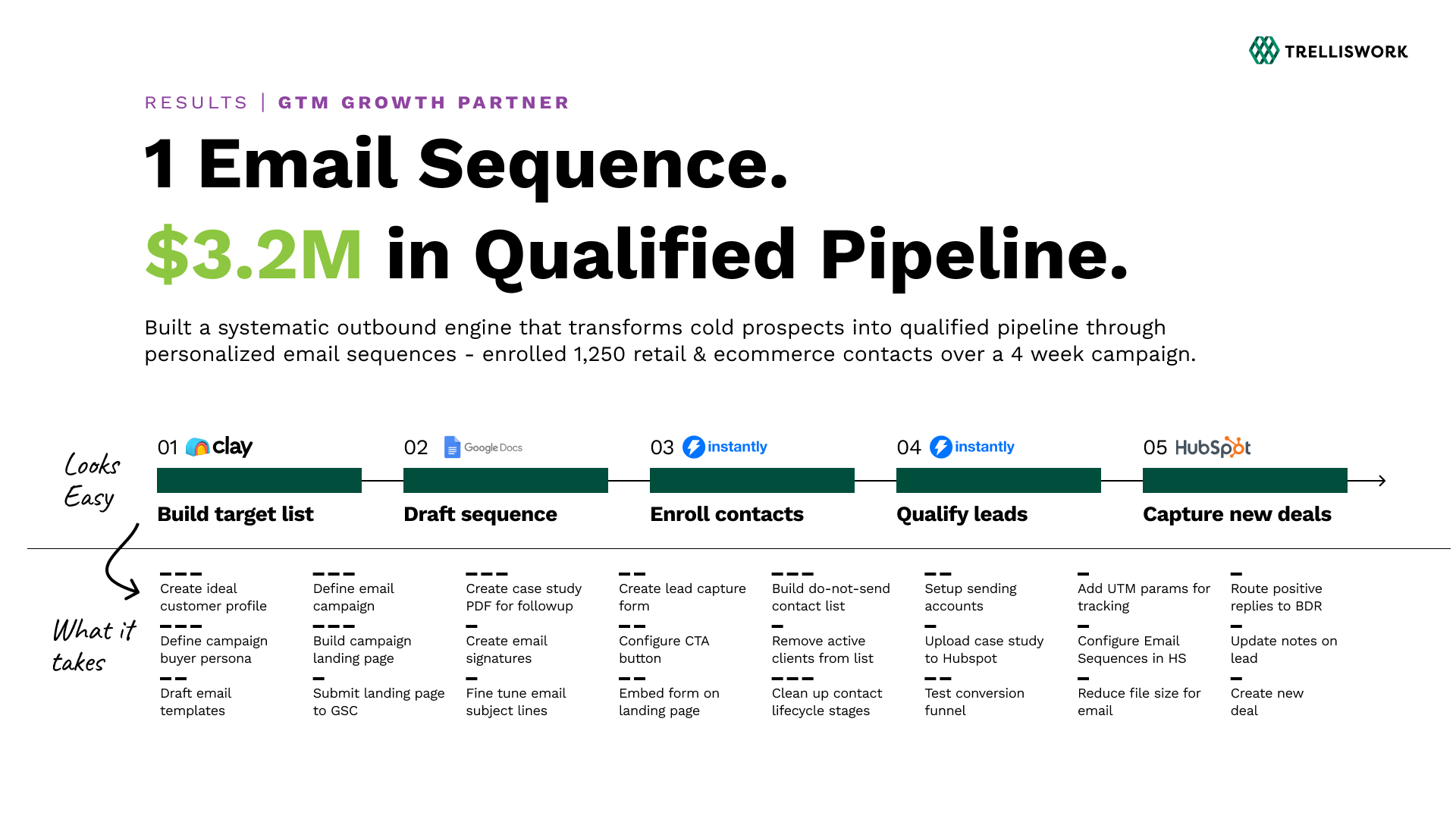
When a warehouse automation leader needed to accelerate pipeline generation, we built and launched targeted outbound sequences focused on their ICP in supply chain and warehouse automation. Within four weeks, the campaigns generated $3.2M in qualified deal pipeline across 3 opportunities..

The system worked because we combined tight ICP filtering (decision-makers at companies with specific automation needs), clear value messaging (ROI-focused proof points), and disciplined follow-up sequences. No magic. Just systematic execution of the fundamentals outlined above.

Outbound Email Sequence Details - Below the Surface

Get Started Today

What are you waiting for? Launch your outbound sequence this week! Or, if you’d rather have someone else just take care of it for you, let’s connect.  

FAQs

Q: How much does it cost to run outbound email?
Clay runs $150–300/month depending on enrichment volume. Instantly costs $30–100/month per inbox. Total monthly spend for a small operation: $200–500. Compare that to a single trade show or one month of paid ads.

Q: How long until I see results?
You'll get initial replies within 3–5 days of launch. Meaningful signal (10+ conversations) requires 2–4 weeks and 500+ sends. Outbound is fast compared to SEO or content marketing, not instant.

Q: Do I need multiple domains?
Start with one well-configured domain. Add sender rotation (multiple inboxes on different domains) when you exceed 50 sends per day or want to protect your primary domain reputation.

Q: How many emails should be in my sequence?
Three to five emails. Three is minimum for adequate follow-up. More than five rarely improves response rates and risks annoying prospects.

Q: What's a good response rate?For B2B outbound: 1–3% positive reply rate is standard. 5%+ is excellent. Anything below 1% signals ICP or messaging problems. Track total replies (including negative) to gauge overall engagement.

Read More
Articles

October 6, 2025

B2B visibility requires authenticity. No more, "Build it and they will come" - Authority content and real voices build trust to help break through the noise.

Your marketing content is invisible. Not because it's bad. Because algorithms have decided no one needs to see it.

Here's what changed: the filtration layer moved from human brains to machines. We used to consume everything and decide what mattered. Now algorithms decide what we see before we even know it exists. This makes breaking through harder than ever.

The Algorithm Problem

Think about how you find information today. LinkedIn feeds you content based on what you already engage with. News sites show you stories that match your interests. Search results reflect your past behavior.

This creates echo chambers. If you run a company trying to reach new customers outside your existing network, those potential customers will never see you. The algorithm keeps them comfortable in their bubble. You stay trapped in yours.

The math is brutal: smaller companies face the biggest visibility challenge of their careers while enterprise brands can afford to be everywhere at once.

Trust Collapsed Overnight

Spot a brand that looks fake and your trust evaporates instantly. Once lost, trust takes forever to rebuild. Maybe never.

AI-generated content made this worse. Companies push out 15 articles at the click of a button. They all sound the same. They all say nothing. Readers can tell.

When your content looks like everyone else's AI slop, people assume everything you do is low quality. You've commoditized yourself down to the lowest common denominator.

Not all visibility is good visibility.

What Actually Works

Put out authority content or don't bother. Authority means original thought from real people at your company. Not regurgitated advice that ChatGPT could write. Not generic best practices everyone already knows.

You need content that reflects your actual experience and opinion. The things you bring to market that no one else does.

Amplify your leaders. People trust people, not brands. Your founders and executives should share their real perspectives. The goal is connecting directly with individuals, not pushing derivative brand content no one will read.

We see this in our own business. Most of our work comes from referrals. People we've worked with tell their friends. This works because they like working with us, not because of our content marketing. Relationships still matter most.

Be authentic at scale. This sounds like a contradiction but it's not. Find ways to capture real conversations, real client work, real reactions to what's happening in your market.

Some options that work:

  • Podcasts and video where people can see and hear actual humans
  • Customer interviews and testimonials
  • Case studies that show real problems you solved
  • Content based on actual sales conversations and client challenges

Video is still hard to fake. For now. When that changes, we're back to conferences and metal detectors to verify you're human.

Leverage your network. The people who know you can vouch for you. This breaks through algorithmic barriers. One warm introduction does more than a thousand cold emails.

The B2B Influencer Question

LinkedIn has its own influencer economy now. Some people became authorities on go-to-market strategy, startup launches, and other B2B topics.

This creates another echo chamber problem. You see the same voices saying similar things. Plus you can spot the ones using AI to generate "disruptive" takes designed to trigger emotional responses.

The pattern is obvious: challenge, response, "here's the real thing." It all sounds the same.

Real influencers share actual experience. Fake ones chase engagement.

What This Means for You

Build it and they will come never worked. Today it's completely dead. 

You need a plan for visibility that goes beyond publishing content and hoping. Focus on:

  1. Quality over quantity. One great piece beats fifteen mediocre ones.
  2. Real human voices. Your actual team sharing actual insights.
  3. Direct connections. Network activation, partnerships, referrals.
  4. Multiple formats. Written content, video, conversations.
  5. Consistency. Algorithms reward regular activity.

The companies winning today blend traditional relationship building with modern distribution. They use paid ads and PR and content marketing, but as part of a larger system. Not as magic bullets.

The Choice is Yours

Visibility is a trust problem disguised as a distribution problem. You can't algorithm your way to trust. You build it through authentic connections and valuable content that reflects real expertise.

Stop trying to game the system. Start being worth finding.

Read More
Articles

May 15, 2025

Map the B2B buyer journey with full-funnel marketing to create content that guides customers and grows sales after purchase.

The Cost of Content Marketing without Direction

Your marketing team is busy. Content is being created. Social posts are going out. Campaigns are running. But something's missing—actual business growth that can be directly tied to these activities. Sound familiar?

This disconnect is what happens when companies engage in "random acts of marketing"—activities without clear strategic alignment to how their customers actually buy. For most mid-market B2B companies, this approach means wasted resources, frustrated teams, and growth that remains stubbornly dependent on founder relationships rather than scalable marketing systems.

The truth is uncomfortable but necessary to acknowledge: most companies are leaving significant growth opportunities untapped because they've failed to map their marketing efforts to their ideal customers' actual buying journey. They're creating content without purpose, measuring metrics without meaning, and wondering why their marketing investments aren't delivering the expected returns.

The cost isn't just in wasted marketing dollars. It's in the missed revenue opportunities, the extended sales cycles, and the competitive disadvantage that compounds over time.

The Marketing Activity Trap

Marketing teams often fall into what we call the "activity trap"—the false belief that being busy with marketing activities means being effective at driving business results. This manifests in several ways:

First, there's the metrics mirage. Your dashboard shows increasing likes, shares, and pageviews. Reports highlight growing email open rates and expanding follower counts. But these vanity metrics rarely translate to pipeline or revenue growth. Teams celebrate the activity metrics while the outcome metrics—qualified leads, sales opportunities, and revenue—remain stagnant.

Then there's the content treadmill. Content creation becomes an end unto itself, with teams constantly producing blogs, videos, and social posts without understanding their purpose in moving buyers through their journey. The focus shifts to production volume rather than strategic impact, creating a resource-intensive cycle that yields diminishing returns.

Perhaps most damaging is the false correlation between marketing activity volume and marketing effectiveness. Teams point to everything they're doing as evidence of progress, but when pressed on results, the connection becomes tenuous at best. This creates a dangerous illusion of progress while the business remains stuck.

The result is a significant resource drain—time, talent, and budget poured into unfocused efforts with unclear returns. The opportunity cost is substantial, as these same resources could be driving meaningful growth if aligned with a clear understanding of the buyer journey.

Three Myths About B2B Marketing Effectiveness

Myth 01: More content equals more leads

The "content volume" strategy persists despite overwhelming evidence that quality and strategic alignment trump quantity every time. Companies producing fewer but highly targeted content pieces that address specific journey stage needs consistently outperform those flooding the market with unfocused content.

This myth leads to diminishing returns as content teams expand production without expanding impact. Resources get stretched thin, quality suffers, and the signal-to-noise ratio for your audience decreases. They become less likely to engage with any of your content as the perceived value of each piece declines.

Strategic content aligned to specific journey stages creates a multiplier effect that volume alone never will. One deeply researched, journey-specific piece can outperform dozens of generic posts by actually moving buyers to the next stage.

Myth 02: The buyer journey is linear and predictable

The traditional funnel model suggests a neat progression from awareness to consideration to decision. The reality is far messier. Buyers regularly move back and forth between stages as new information emerges, new stakeholders join the process, or competing priorities shift.

This complexity is amplified in B2B environments where different stakeholders within the same target account may simultaneously occupy different journey stages. The technical evaluator might be in consideration while the financial approver hasn't moved beyond initial awareness.

Rigid funnel models fail to capture this complexity and lead to misaligned content strategies that assume a straightforward progression that rarely exists in reality. Effective journey mapping acknowledges this fluidity and plans for non-linear movement.

Myth 03: Marketing's job ends at the sale

Perhaps the most costly myth is that the buyer journey concludes when the contract is signed. This overlooks the critical post-purchase phases where the real growth potential often lies.

Most marketing teams focus exclusively on pre-purchase stages, missing the enormous opportunity to develop existing customers into advocates who drive new business. A satisfied customer who actively promotes your solution is frequently more valuable than dozens of new leads.

Companies that extend their journey mapping into post-purchase phases unlock compounding growth as customer advocacy becomes a powerful demand generation engine. The most effective growth systems aren't just about acquiring new customers, but systematically developing existing ones into growth catalysts.

A Framework for Understanding your B2B Buyer's Journey

One of the most important yet overlooked realities of B2B marketing is the uneven distribution of your audience across journey stages. The majority of your potential buyers—often 70% or more—are in the Awareness stage at any given time. A smaller percentage, perhaps 20%, are actively in Consideration. Only a small fraction, typically less than 10%, are ready to make a Decision.

the b2b buyer journey map

This distribution has profound implications for your content strategy and resource allocation. Most companies make the mistake of overinvesting in Decision stage content (detailed product comparisons, pricing pages, technical specifications) while underinvesting in the Awareness content that addresses the much larger portion of their audience.

Resource allocation should generally mirror this distribution, with the majority of your content efforts focused on education and awareness, a moderate amount on consideration, and a proportionally smaller (but highly optimized) effort on decision content.

Customer Acquisition: Educate and Validate

Each journey stage requires not just different content topics but different content approaches:

Awareness stage content educates your audience about their challenges and opportunities. It builds credibility without selling. The goal isn't to promote your solution but to demonstrate your understanding of the problems your audience faces. This might include industry research, trend analysis, or educational content that helps prospects better understand their own challenges.

Consideration stage content provides encouragement that your approach is valid and builds confidence in your differentiated perspective. Here, you transition from general education to sharing your specific methodology or approach. Case studies, methodology explanations, and comparison frameworks perform well at this stage.

Decision stage content offers validation that removes final obstacles and reinforces that choosing your solution is the right decision. This includes proof points, implementation details, ROI analyses, and specific outcome commitments. The goal is to remove final barriers to purchase by addressing remaining objections.

Retention & Expansion: Deliver and Reinforce

The journey continues after purchase, evolving through three critical phases that most companies completely ignore:

Sponsor is your initial internal champion who brought your solution into their organization. They've put their professional reputation on the line and need ongoing support to demonstrate the value of their decision. Content at this stage should help them communicate early wins and implementation progress to their internal stakeholders.

Champion represents the expansion of internal advocacy beyond the initial sponsor. Your content should help existing customers educate their colleagues about your solution's value, empowering them to become internal advocates. Training materials, internal presentation templates, and success metrics frameworks are valuable here.

Advocate is the ultimate goal—a customer who actively promotes your company to external prospects, effectively becoming part of your marketing team. Content for advocates includes shareable success stories, speaking opportunity support, and peer networking resources that enhance their professional standing while promoting your solution.

By mapping content to all six stages—not just the pre-purchase three—companies create a complete growth system rather than just a lead generation machine.

Systemizing Your B2B Buyer Journey: A 4-Phase Approach

Everything is a system. From inputs to outputs, you can build a content engine and growth system that meets your ideal customers where they are, and positions your brand as a trusted authority. Here are the phases we walk through with our clients, and with our own go-to-market efforts as we engineer the growth systems that build audiences and establish industry trust.

Phase 01

Defining your ICP with precision

The foundation of effective journey mapping starts with precise definition of your Ideal Customer Profile (ICP). This goes well beyond basic demographics like company size and industry to include behavioral characteristics, common challenges, success metrics, and buying processes.

Understanding the actual challenges and goals of your ideal customers provides the thematic foundation for your content. Their buying process defines the structure of your journey map. Without this precision, your content will lack both relevance and strategic alignment.

The connection between ICP definition and content strategy effectiveness is direct and measurable. We've seen companies increase content engagement rates by over 200% simply by refining their ICP definition and aligning existing content more precisely to the specific challenges of that audience.

Begin by interviewing your best existing customers, focusing not just on why they bought your solution but on their entire buying process. What triggered their search? What alternatives did they consider? Who was involved in the decision? What concerns almost prevented the purchase? These insights form the basis of your journey map.

Phase 02

Mapping content needs to journey stages

With your ICP clearly defined, the next step is auditing your existing content and categorizing each piece by journey stage. This typically reveals significant imbalances—most companies discover they're overweighted toward either early awareness content (thought leadership without clear next steps) or late-stage decision content (product features without contextual education).

Identify gaps in your content coverage across the journey, particularly at transition points between stages. What content do prospects need to move from awareness to consideration? What validation content is missing that would accelerate decisions?

Prioritize content creation based on the journey stage distribution we discussed earlier, with appropriate weighting toward awareness and consideration stages where most of your audience resides.

Develop detailed content briefs that explicitly connect to journey stages and ICP pain points. Each brief should identify which stage the content targets, what questions it answers for that stage, and what specific action it intends to motivate.

Phase 03

Creating content with purpose, not volume

With your journey map established, content creation becomes more focused and purposeful. Each piece is designed with specific journey stage transitions in mind—not just to engage, but to move the reader to the next stage in their buying process.

This approach naturally builds content that leads prospects through their journey. An awareness piece doesn't just educate; it creates interest in your specific approach that leads to consideration content. Consideration content doesn't just differentiate; it reduces purchase anxiety and leads naturally to decision content.

The focus shifts from production volume to quality engagement and journey progression. Teams measure success not by how much content they create but by how effectively that content moves prospects forward.

Implement content workflows that connect directly to your journey mapping. Content briefs, editorial calendars, and performance metrics should all reference the journey stage and intended progression each piece supports.

Phase 04

Measuring what matters

The final step is establishing KPIs tied to journey progression, not just engagement. Traditional metrics like page views and time on page still matter but must be interpreted in the context of journey movement.

Track content performance by journey stage, comparing engagement across similar content types within each stage. This reveals which approaches are most effective at each stage of the buying process.

Measure velocity of movement between journey stages. How quickly do prospects move from first awareness touch to consideration content engagement? How many consideration touches typically occur before decision stage engagement? These metrics help optimize both content and nurture flows.

Most importantly, connect content engagement patterns to actual sales outcomes. Which content pieces most often appear in the engagement history of closed deals? Which combinations of content correlate with higher close rates or larger deal sizes? These insights allow you to double down on the most impactful content for actual revenue, not just engagement.

Signs You're Getting It Right, Beyond Vanity Metrics

How do you know when your journey mapping efforts are working? Look for these indicators that go beyond basic engagement metrics:

Qualified leads submitting contact forms with visible trails of content engagement. When leads come in with a history of engagement across multiple journey stages, they're typically more qualified and sales-ready than those who arrive directly at decision content.

The ability to map specific content interactions to different stages of the buyer journey. Your analytics should show clear patterns of how prospects move through your content, revealing which pieces effectively transition them to next stages and which create dead ends.

Shortened sales cycles as prospects move through stages more efficiently. A well-mapped content journey pre-educates prospects, answers common objections, and builds confidence before sales conversations even begin, reducing the time required to close.

Increased referral business from existing customers. This indicates successful execution of the post-purchase journey stages, transforming customers into advocates who actively bring new prospects into your pipeline.

A growing sense of intuition about what works, backed by meaningful data. Perhaps the most satisfying indicator is when your team develops a feel for effective content—an intuition that's consistently validated by performance data.

When these indicators appear, you'll know you've successfully transformed from random marketing activities to a strategic, journey-aligned growth system.

Give Content Marketing the Intention it Needs

The cost of continuing with unfocused marketing activities isn't just wasted budget—it's the opportunity cost of growth not achieved and market position not secured. In today's competitive landscape, the gap between companies with journey-mapped strategies and those engaging in random marketing activities widens every quarter.

Companies that align their content to the complete buyer journey—including the critical post-purchase phases—create a sustainable competitive advantage. They don't just acquire customers more efficiently; they transform those customers into growth engines through systematic advocacy development.

The shift from random activity to strategic journey alignment is what separates growing companies from stagnant ones. It's the difference between marketing that constantly needs to justify its existence and marketing that demonstrably drives business growth.

Is your current marketing strategy aligned to your customers' actual buying journey? Are you creating content with clear purpose for each stage, or simply producing content for its own sake? Most importantly, have you extended your journey mapping beyond the sale to capture the full growth potential of your existing customers?

Take the first step toward strategic, journey-aligned marketing. Request a free GTM assessment to map your company's current content to the B2B buyer journey and identify the highest-impact opportunities to transform your marketing from random activities to strategic growth.

Read More